
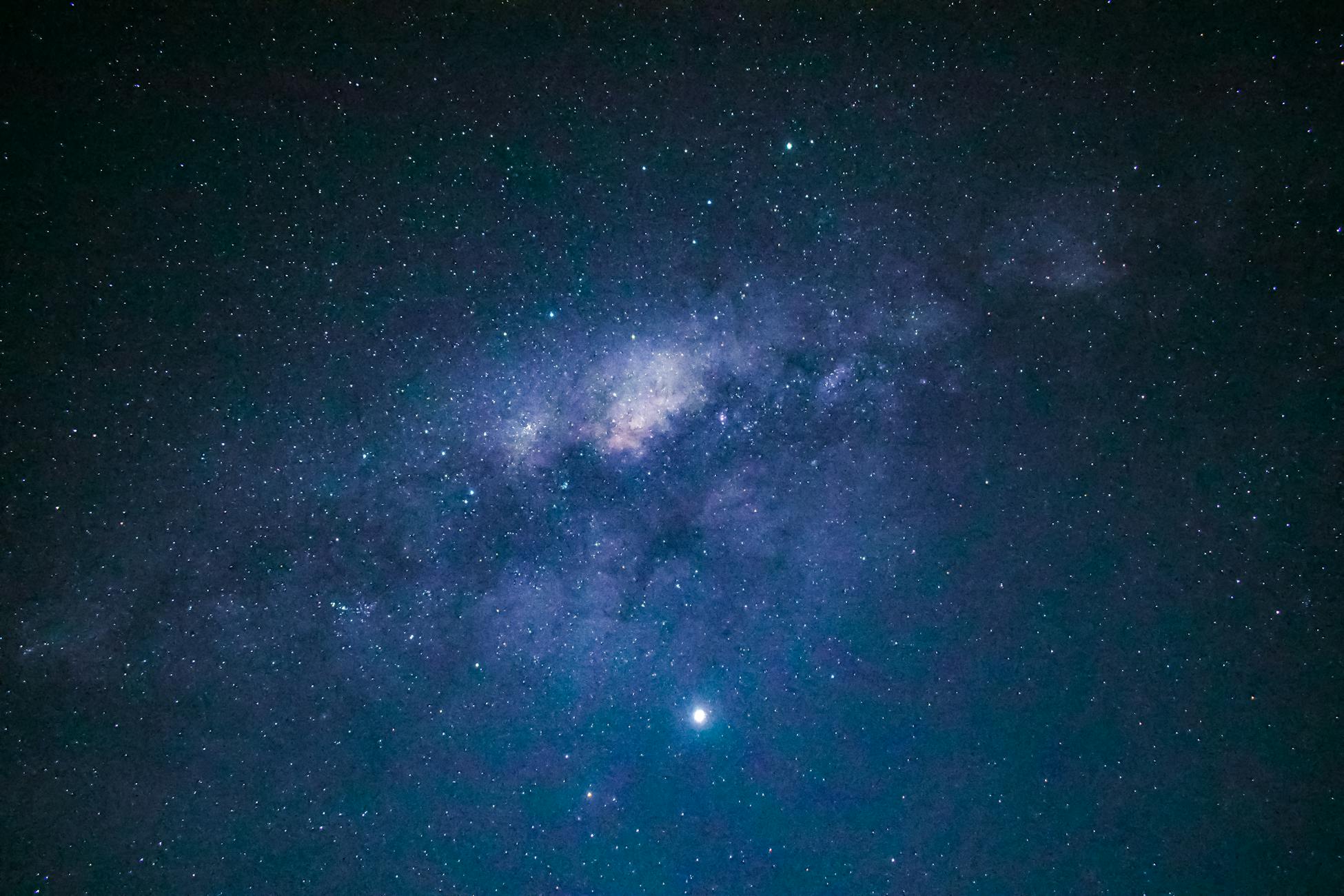
The headline number for the object at the center of the Milky Way is four million solar masses, and the number for how fast the solar system is moving around it is roughly 514,000 miles per hour. Both figures are correct in the narrow sense that working astronomers will defend them. Both are also slightly misleading in ways that matter, because they suggest a kind of motion that humans should be able to feel, and the reason no one feels it is more interesting than the speeds themselves.
The popular framing tends to go like this: there is a monster at the center of the galaxy, the planet is hurtling around it at unimaginable speed, and the fact that no one notices is a kind of cosmic joke about human scale. That framing is approximately right in its emotional effect and almost entirely wrong in its physics. Motion at constant velocity, even very large constant velocity, is not something a body inside a closed system can detect. The galaxy is the closed system. The reason no one feels 514,000 mph is the same reason no one feels 67,000 mph around the sun, or 1,000 mph of equatorial rotation, or any of the other velocities stacked underneath a person standing in a kitchen.
What Sagittarius A* actually is
The object at the galactic center is designated Sagittarius A*, pronounced “Sagittarius A-star,” and it sits behind the dust lanes of the constellation Sagittarius near the border with Scorpius. It is invisible at optical wavelengths because roughly 30 magnitudes of extinction sit between Earth and the galactic core, which is why every image of the region comes from radio, infrared, or X-ray instruments. Sagittarius A* sits roughly 26,000 light-years from Earth, and the mass inferred from the orbits of stars whipping around it lands near 4.1 million times the mass of the sun.
The part worth slowing down on is how that mass number was derived. It is not a direct measurement of the black hole itself. It is the gravitational signature inferred from tracking individual stars, most famously S2, as they sling around an invisible focus at velocities exceeding several thousand kilometers per second at perihelion. The Event Horizon Telescope released a resolved image of the shadow in May 2022, but the mass figure predated that image by decades and came from Keplerian orbital fitting, which is the same mathematics used to weigh binary stars or planetary systems. The number is a calculation, not a measurement, and the error bars on it are real even if they are narrow.
There is also an open question about whether the central concentration is entirely a single black hole. A recent analysis argued that a dense core of dark matter could in principle produce a similar dynamical signature to a supermassive black hole, though the resolved shadow imaging strongly favors the conventional interpretation. The point is that even the headline identity of the object is a model-dependent claim, not a photograph of an event horizon being weighed.
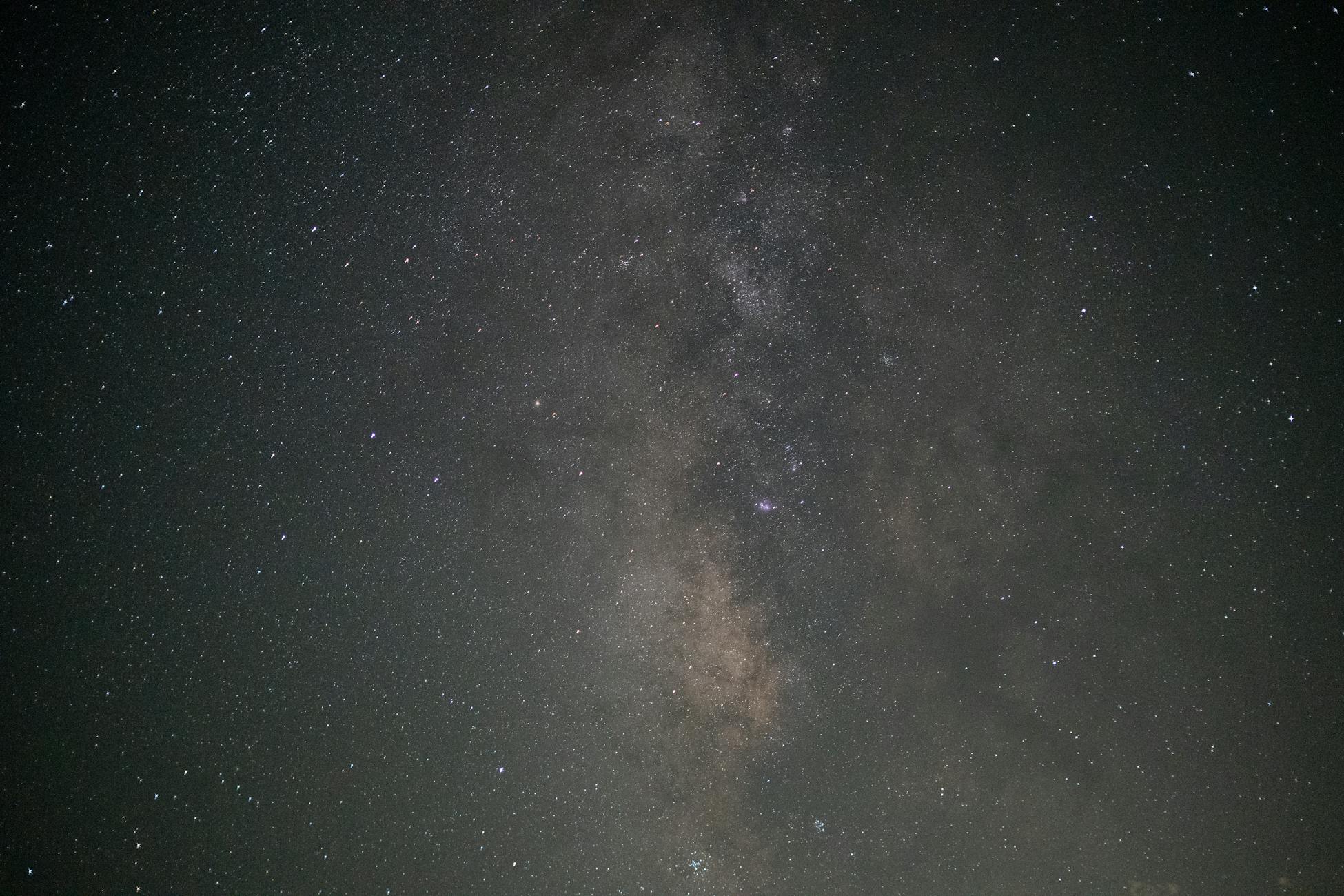
The 514,000 mph figure and what it actually measures
The solar system’s orbital speed around the galactic center is usually given as somewhere between 220 and 230 kilometers per second, which converts to roughly 492,000 to 514,000 miles per hour depending on which local standard of rest is used. The value is not a single, agreed-upon constant. It is derived from a combination of stellar proper motions, maser observations of objects with known geometric distances, and a model of the galactic rotation curve. Different methods give slightly different answers, and the figure quoted in popular accounts is usually the upper end of a range that working astronomers treat as approximate.
One full orbit at that speed takes roughly 225 to 250 million years. That period is sometimes called a galactic year, and the sun has completed somewhere around 20 of them since it formed. The Earth has been around for about four and a half galactic years. Dinosaurs went extinct less than one galactic year ago. These are useful intuition pumps, but they also obscure something important: the sun’s path around the galactic center is not a clean ellipse. It bobs above and below the galactic plane, drifts in radial distance, and is perturbed by spiral-arm passages and giant molecular clouds. The 514,000 mph figure is an instantaneous tangential speed, not a stable orbital parameter.
Why no one feels any of it
The reason a person standing in a kitchen does not feel any of the velocities involved comes down to a principle Galileo wrote about in 1632 and that Einstein generalized in 1905. Uniform motion is undetectable from inside the moving frame. What bodies actually feel is acceleration, which is the rate at which velocity changes. Sitting in a car going 70 mph on a straight highway feels identical to sitting in a parked car as long as the road is smooth and the windows are closed. Hit the brakes or take a sharp corner and the body registers it instantly.
The orbital acceleration of the solar system around the galactic center is staggeringly small in absolute terms. At a radius of 26,000 light-years and an orbital velocity of 230 km/s, the centripetal acceleration works out to roughly 2 x 10^-10 meters per second squared. That is about twenty billion times smaller than the surface gravity of Earth. No organ in the human body, and no instrument in a typical laboratory, can resolve an acceleration that small against the noise floor of ordinary gravity. The galactic orbit is, for biological purposes, indistinguishable from rest.
The same logic explains why no one feels the 67,000 mph of Earth’s orbit around the sun, or the 1,000 mph of rotational velocity at the equator. The accelerations associated with those motions are present but tiny. Earth’s rotational acceleration at the equator is about 0.034 m/s^2, which is just barely measurable as a slight reduction in apparent gravity, and the orbital acceleration around the sun is about 0.006 m/s^2, which is below the threshold of human perception. The galactic orbit is smaller still by orders of magnitude.

The stacked velocities no one notices
The picture gets stranger when the velocities are stacked. A person on Earth is rotating with the planet at up to 1,040 mph depending on latitude, orbiting the sun at 67,000 mph, moving with the sun around the galactic center at roughly 514,000 mph, and drifting with the entire Local Group toward the Great Attractor at something like 1.3 million mph relative to the cosmic microwave background rest frame. None of these motions are felt because none of them produce significant acceleration on biological timescales. The total motion is real, but it is invisible from inside.
That last figure, the motion relative to the cosmic microwave background, is the closest astronomy gets to an absolute velocity, and even it is defined relative to a particular reference radiation rather than to space itself. There is no preferred rest frame in general relativity. The 514,000 mph number is meaningful only because it is measured against the local standard of rest defined by nearby stars, which themselves are in motion. Counter-intuitive astronomical facts can create a sense of dissonance partly because words like “speed” and “motion” carry intuitions from everyday physics that do not transfer cleanly to galactic scales.
What Sagittarius A* is doing besides anchoring the orbit
A supermassive black hole at four million solar masses sounds enormous until it is compared to the rest of the galaxy. The Milky Way’s total mass, including dark matter, is somewhere between 1 and 1.5 trillion solar masses. The central black hole is therefore roughly 0.0003 percent of the galaxy by mass. It does not dominate galactic dynamics. The solar system is not orbiting the black hole in any meaningful sense; it is orbiting the enclosed mass within 26,000 light-years of the galactic center, the vast majority of which is stars, gas, and dark matter rather than the black hole itself.
This is why Sagittarius A* is sometimes called “quiet” by the standards of supermassive black holes. It accretes very little material compared to active galactic nuclei in other galaxies, and its luminosity is a tiny fraction of the Eddington limit. Other systems are far more dramatic. A pair of black holes recently identified at roughly 60 billion solar masses combined dwarfs the Milky Way’s central object by four orders of magnitude. The galactic center is, by cosmic standards, modest. Writers on this site have covered how stellar-mass black hole jets carry away roughly 10 percent of infalling energy, and the same physics scaled up determines how visible a supermassive black hole becomes from across a galaxy.
What the headline gets right and what it edits out
The popular version of the fact is useful as an attention hook. It is true that the central object weighs roughly four million solar masses. It is true that the solar system moves at roughly 514,000 mph relative to the local standard of rest. It is true that no one feels any of it. What gets edited out is the reason none of that motion is detectable, which is not that humans are too small or too distracted but that the physics of uniform motion does not produce sensation. The galactic orbit is real and the speed is real, but the experience of moving requires acceleration, and the acceleration involved is roughly twenty billion times below the threshold of human perception.
The other thing edited out is how much of the headline is inference rather than direct measurement. The mass of Sagittarius A* was calculated from stellar orbits before it was imaged. The orbital velocity of the sun is derived from a galactic rotation model with real uncertainty. The 26,000 light-year distance is itself a calibrated estimate rather than a triangulated geometry. The numbers are defensible central estimates within wide envelopes, and the fact that they have become canonical does not change the fact that they are model outputs. The galaxy is moving the way the model says it is moving, and the model is the best one available, but the headline confidence is a little tighter than the underlying physics warrants.
The part of the story that survives all the caveats is the simple geometric fact that a body roughly 26,000 light-years from a central mass of a few million suns, embedded in a much larger distribution of stars and dark matter, traces a slow loop on a timescale of a quarter billion years and feels nothing while doing it. That is not a cosmic joke. It is the predictable consequence of inertial motion in a smooth gravitational potential, and it is the same reason a passenger in a steady airliner can pour a cup of coffee without spilling it. The galaxy is the airliner. The coffee stays in the cup.
