
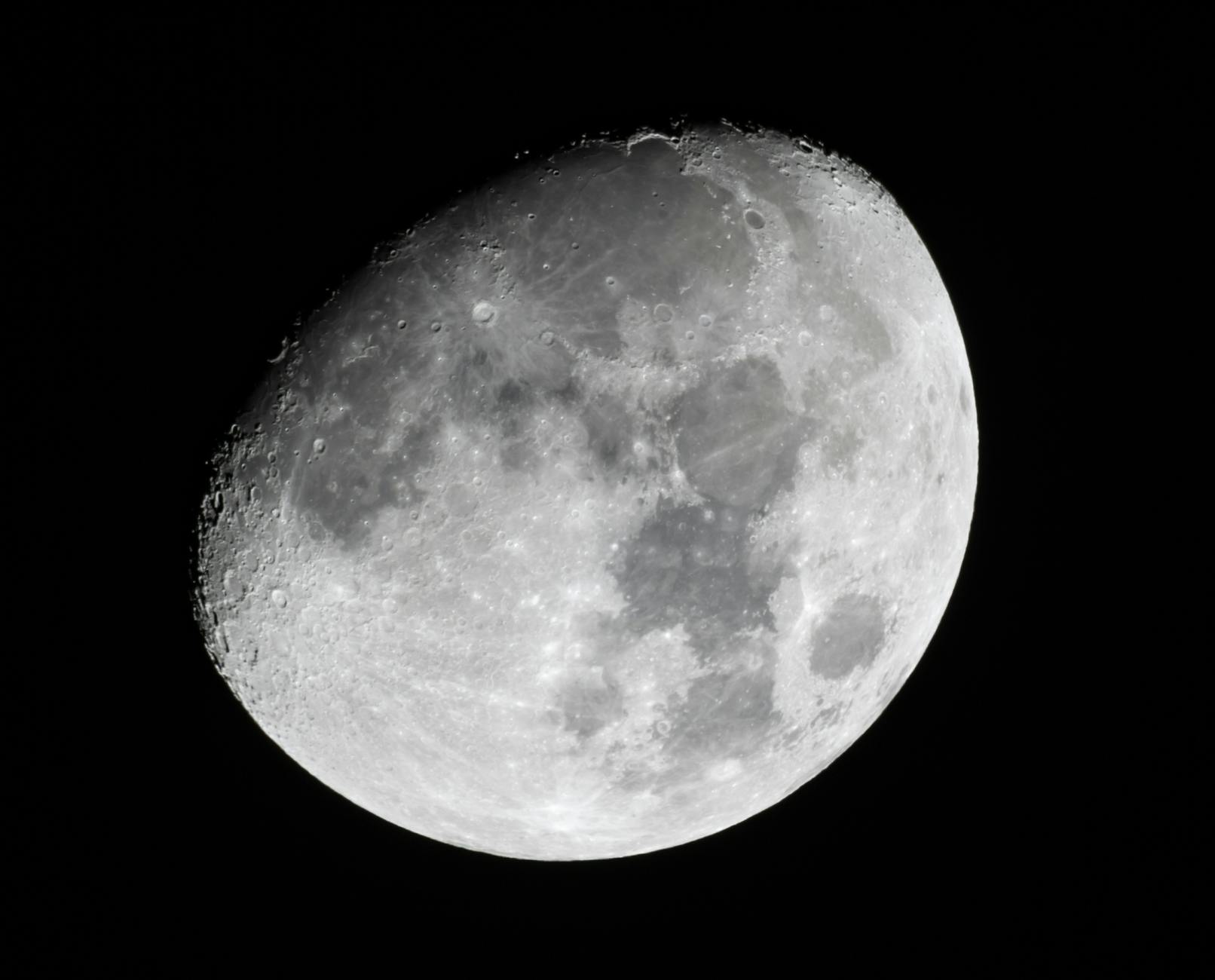
Apollo 11 astronauts Buzz Aldrin and Neil Armstrong left a suitcase-sized array of corner-cube retroreflectors on the Sea of Tranquility in July 1969, and observatories on Earth have been firing lasers at that mirror — and three others placed by later Apollo and Soviet Lunokhod missions — for more than fifty years. The round-trip travel time of those photons, measured to within a few picoseconds, produces the single most precise figure in lunar science. The Moon is receding from Earth at 3.8 centimetres per year.
That number is small enough to sound trivial. It is not. The same measurement, extended forward, eliminates an astronomical phenomenon that human beings happen to be alive at exactly the right moment in geological time to witness.
The popular framing of a total solar eclipse goes like this: the Moon passes in front of the Sun, the sky goes dark for a few minutes, and the corona becomes briefly visible to the naked eye. That framing is correct as far as it goes. The procedural detail that almost never travels with it is the coincidence that makes the whole thing possible.
A coincidence with an expiration date
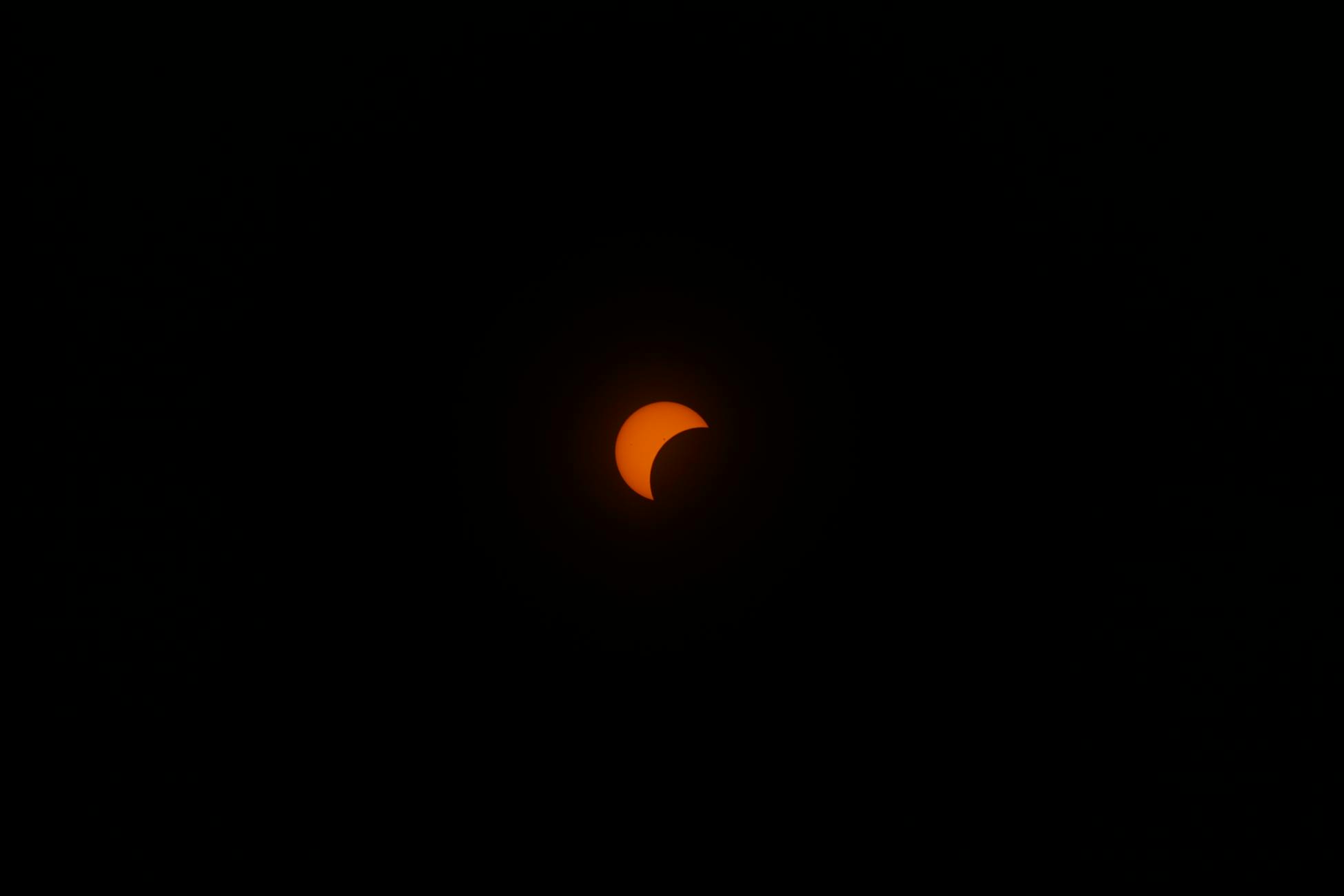
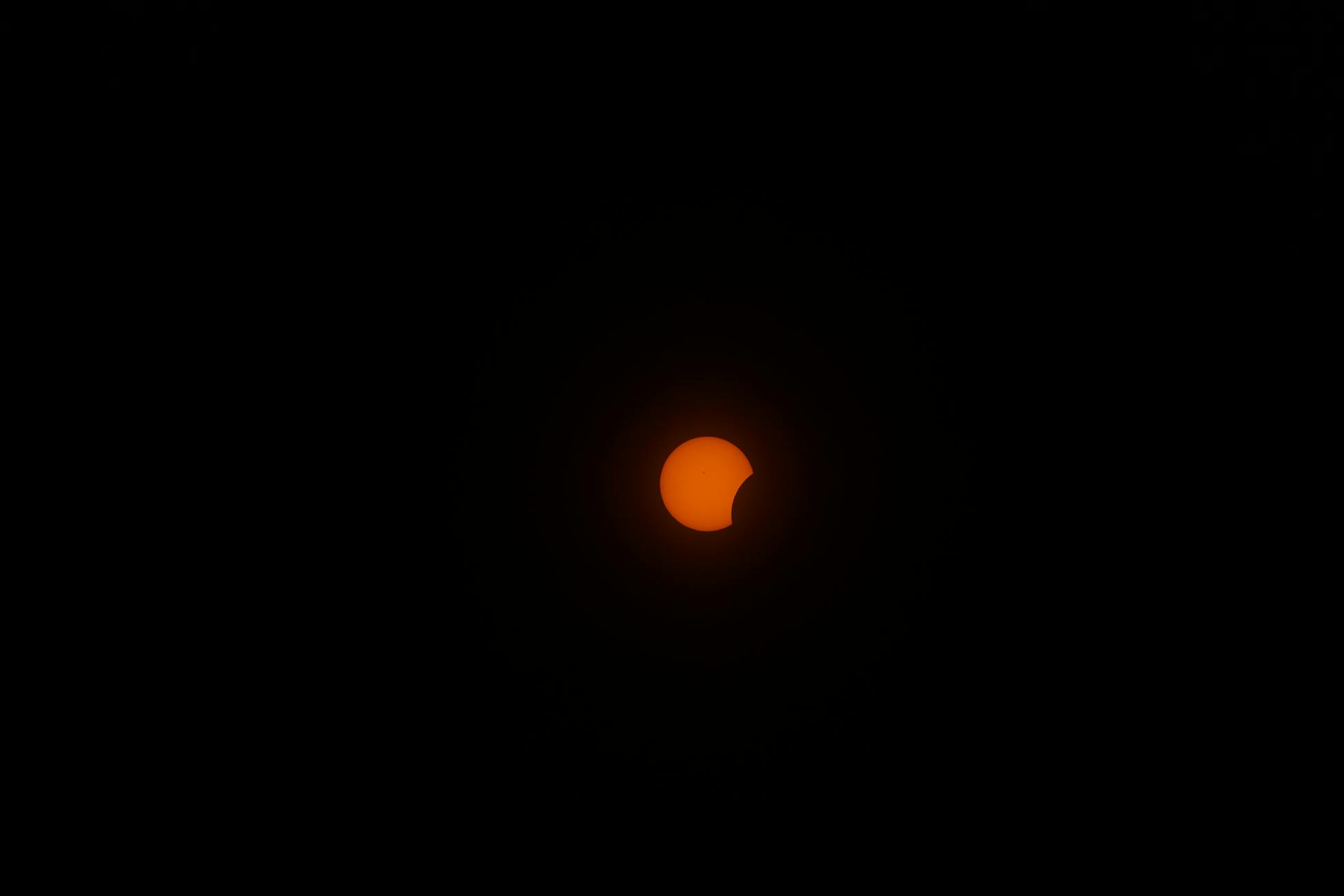
The Sun is roughly 400 times wider than the Moon. It also happens to sit, on average, roughly 400 times farther from Earth. The two ratios cancel. From the ground, the lunar disc and the solar disc subtend almost exactly the same angle in the sky — about half a degree. That is why the Moon can, at specific points in its slightly elliptical orbit, cover the photosphere completely while leaving the corona exposed.
No other planet in the solar system has this geometry. Mars has two moons, both too small and too close to produce anything resembling totality. Jupiter’s largest moons are wildly oversized relative to the Sun as seen from Jovian orbit. The Earth–Moon system is the only place where the ratio holds, and it holds only for a window of cosmic time that human civilisation is currently inside.
The Moon has not always been at this distance. It formed, in the prevailing giant-impact model, roughly 4.5 billion years ago, and the early Earth–Moon separation was on the order of 20,000 to 30,000 kilometres — close enough that the Moon would have dominated the sky and produced eclipses in which the lunar disc was many times larger than the solar one. Total eclipses, in the geometric sense familiar to modern observers, did not exist for most of the Moon’s history. They became possible only after the recession had carried the Moon out to roughly its current distance of 384,400 kilometres.
How the 3.8 centimetres gets measured
The recession is a consequence of tidal friction. Earth’s oceans bulge under the Moon’s gravity, the planet’s rotation drags those bulges slightly ahead of the sub-lunar point, and the gravitational tug of the displaced water transfers angular momentum from Earth’s spin to the Moon’s orbit. Earth’s day lengthens by about 1.7 milliseconds per century. The Moon, gaining orbital energy, spirals outward.
The value of 3.8 centimetres per year is not a model output. It is a direct measurement, repeated for decades through the Lunar Laser Ranging Experiment, in which observatories including the Apache Point facility in New Mexico and the Côte d’Azur station in France time the return of laser pulses bounced off the Apollo and Lunokhod retroreflectors. The current ranging precision is on the order of millimetres. The recession rate is robust to roughly a millimetre per year of uncertainty.
That detail matters more than it sounds. Most striking numbers in popular astronomy carry wide error bars or model dependencies. The lunar recession does not. It is one of the cleanest long-baseline measurements in the discipline, and it directly constrains when the geometric basis for total solar eclipses will disappear.
The end of totality, in numbers
The Moon’s apparent angular size shrinks as it recedes. The Sun’s apparent angular size is essentially fixed on relevant timescales — the Sun’s own slow evolution will eventually inflate it, but that is a separate story unfolding over hundreds of millions to billions of years. The eclipse-relevant variable is lunar distance.
At the current recession rate, the Moon’s average angular diameter will fall below the Sun’s average angular diameter in approximately 600 million years. After that point, the lunar disc will no longer be large enough, even at its closest approach in a given orbit, to fully cover the solar photosphere. What remains will be annular eclipses — the ring-of-fire configuration in which a thin band of solar surface stays visible around the lunar silhouette — and partial eclipses. The corona, the chromosphere, the diamond ring, the brief manageable daylight darkness in which stars become visible: those phenomena will be gone.
The figure of 600 million years is approximate. It depends on assumptions about the future stability of the recession rate, which is itself a function of continental configuration, ocean depth distribution, and tidal resonance — all of which change on geological timescales. The reasonable reading is that totality has somewhere between roughly 500 million and 800 million years left as a feature of the Earth–Moon system. Beyond that envelope, it ends.
What humans happen to be witnessing
The current epoch is therefore a narrow strip in deep time during which the Earth–Moon–Sun geometry permits the specific visual phenomenon that draws crowds to remote stretches of land every eighteen months or so. The 2024 North American eclipse, the 2026 European track that will cross Iceland and Spain, and other upcoming total solar eclipses are all occurring inside this window. So did every total solar eclipse ever observed by a human being — by Babylonian astronomers, by the Greek scholars who used the 585 BCE eclipse to date the Battle of Halys, by Edmond Halley mapping the 1715 path across England, by Arthur Eddington testing general relativity from Príncipe in 1919.
The window is wide enough that no individual civilisation will see it close. Hominins evolved roughly six million years ago. Recorded astronomy spans perhaps four thousand. Six hundred million years is a hundred thousand times longer than the entire span of human history to date. Whatever beings exist on Earth in that distant future — if Earth remains habitable, which is its own large uncertainty — will not see what current observers see, because the geometry will no longer support it.
Why the scarcity matters to people, not just physics
The Earth–Moon recession is a technical fact. The reason it produces an emotional response, when stated plainly, is that it inverts the usual relationship between human experience and astronomical time. Most celestial phenomena are older and longer-lasting than any observer. The night sky a Sumerian astronomer saw is, in its main features, the night sky visible from a dark site tonight. The constellations have drifted slightly, the precession of the equinoxes has rotated the celestial pole, but the broad picture is stable.
Totality is different. It is a feature with a beginning, a middle, and an end, and human civilisation is sitting somewhere in the late middle. The emotional charge of total eclipses appears to come partly from the perception of cosmic vastness, and partly from the awareness of one’s small position within it. In a piece on lunar eclipses and awe, the distinction between wonder and awe is framed as the difference between curiosity at the unexpected and the felt response to something that humbles the observer.
The scarcity dimension is rarely included in that framing, but it changes the calculation. A total eclipse is not only vast; it is also temporally bounded in a way most cosmic phenomena are not. The perception of finitude tends to sharpen attention and intensify meaning-making — a pattern consistent with temporal scarcity effects. A phenomenon that has 600 million years left is, in human terms, effectively permanent. A phenomenon that exists only inside a 600-million-year window of a 4.5-billion-year planetary history is, in cosmic terms, fleeting.
What the ranging mirrors actually reveal
The retroreflectors on the lunar surface — the Apollo 11, 14, and 15 arrays, plus the Lunokhod 1 and 2 mirrors — are among the longest-running active experiments in space science. They were originally installed to test general relativity, refine the lunar orbit, and constrain the gravitational constant. The recession measurement is, in a sense, a byproduct.
That byproduct now functions as a precise cosmic clock for the disappearance of total solar eclipses. Each year the ranging data confirms the 3.8-centimetre figure. Each year the deadline moves marginally closer. The mirrors are still there, untouched, performing the same passive optical function they performed in 1969, and the photons returning from them carry information that no future human civilisation — if there is one — will be in a position to reproduce, because the phenomenon those measurements help characterise will already be over.
Coverage on this site has previously looked at the engineering and human dimensions of lunar return, including the Artemis II crewed flyby and what astronauts report about the orbital shift in perspective. The recession figure sits in a different register. It is not about what humans are doing in space. It is about what the Earth–Moon system is doing to itself, slowly, in a way that human technology can measure but cannot reverse.
The Moon will keep moving. The next total solar eclipse visible from a populated continent will arrive on schedule, and the one after that, and the one after that, through tens of millions of cycles. At some point in the late Mesozoic-equivalent of Earth’s far future, the last total eclipse will occur — observed or unobserved — and the geometry that produced it will close. The 3.8 centimetres per year is the rate at which that closing is happening, in real time, right now.
