
The Moon is leaving. Not dramatically, not catastrophically, and not on any timescale that will inconvenience anyone reading this — but it is leaving, and the going rate is 3.8 centimetres per year. That number, which sounds like the kind of trivia people forget by the next paragraph, happens to be the slow countdown on one of the strangest coincidences in the solar system: the fact that the Moon, as viewed from Earth, is almost exactly the same apparent size as the Sun. That is what makes a total solar eclipse a total solar eclipse rather than a partial one or a ring. And it is a coincidence with an expiration date.
The popular framing treats eclipses as eternal — a fixed feature of being a human on Earth, like sunsets or tides. That framing is approximately right for the span of a civilisation, but it elides the geometry. Total eclipses are a transient condition of this particular era of the Earth-Moon system. Run the clock back far enough and the Moon was too large in the sky for the corona to ever be visible around it. Run it forward far enough and the Moon will be too small to cover the Sun’s disc at all. Humanity occupies, by accident, the narrow window where the alignment works.
The 3.8 centimetres, and how it is tracked
The recession figure is not a guess. It comes from lunar laser ranging — bouncing pulses of light off retroreflectors left on the lunar surface by Apollo astronauts and the Soviet Lunokhod rovers, then timing the round trip with enough precision to resolve the distance to within millimetres. The technique has been running for more than five decades, and the cumulative dataset is what gives the 3.8 cm/year figure its tight error bars. Earlier this year, researchers at China’s Yunnan Observatories extended the method into daytime measurements, which roughly doubles the available observation window and tightens the long-baseline tracking of lunar motion further.
The recession itself is a tidal phenomenon. The Moon raises a bulge of water and crust on Earth; Earth’s rotation drags that bulge slightly ahead of the Earth-Moon line; the gravitational pull of that displaced mass tugs the Moon forward in its orbit, adding angular momentum and pushing it outward. The same exchange slows Earth’s rotation. The day is getting longer. The Moon is getting farther. Both effects are measured, both are small, and both are inexorable.
3.8 centimetres is roughly the length of a credit card’s short edge. That is the annual change. Over a human lifetime, the Moon retreats by about three metres. Over the span of recorded civilisation — call it 6,000 years — it has moved roughly 230 metres farther away. The distance to the Moon averages about 384,400 kilometres, so 230 metres is a rounding error inside a rounding error. This is why nothing visible changes from one generation to the next.
Why the coincidence works at all
The Sun’s diameter is roughly 400 times the Moon’s. The Sun is also roughly 400 times farther from Earth than the Moon is. That ratio is why their discs appear nearly identical in the sky — about half a degree across each. There is no physical reason the numbers had to line up. The Moon formed from a collision-and-coalescence event roughly 4.5 billion years ago, the Sun’s distance is set by Earth’s orbital radius, and the convergence of their apparent sizes in this particular epoch is, as far as anyone can tell, accidental.
Because the Moon’s orbit is elliptical, the apparent size already varies. When the Moon is near apogee — its farthest point in any given orbit — it appears slightly smaller than the Sun, and an eclipse along its path produces an annular event, a ring of sunlight around a black disc. When it is near perigee, it covers the Sun completely and the corona becomes visible. Totality, in other words, already requires the Moon to be on the near end of its orbital variation. The recession is steadily eating into that margin.
The arithmetic of the end
The standard estimate, derived by extrapolating the current recession rate and accounting for the apogee-perigee variation, is that the last total solar eclipse visible from Earth will occur in roughly 600 million years. The number is a calculation, not a measurement. It assumes the recession rate stays close to its current value, which it will not — the rate depends on the configuration of Earth’s continents and oceans, which determines how much tidal friction the system generates, and continental drift will shuffle those parameters across geologic time. Earlier in Earth’s history, the recession was slower; in epochs of different continental arrangement, it could have been faster.
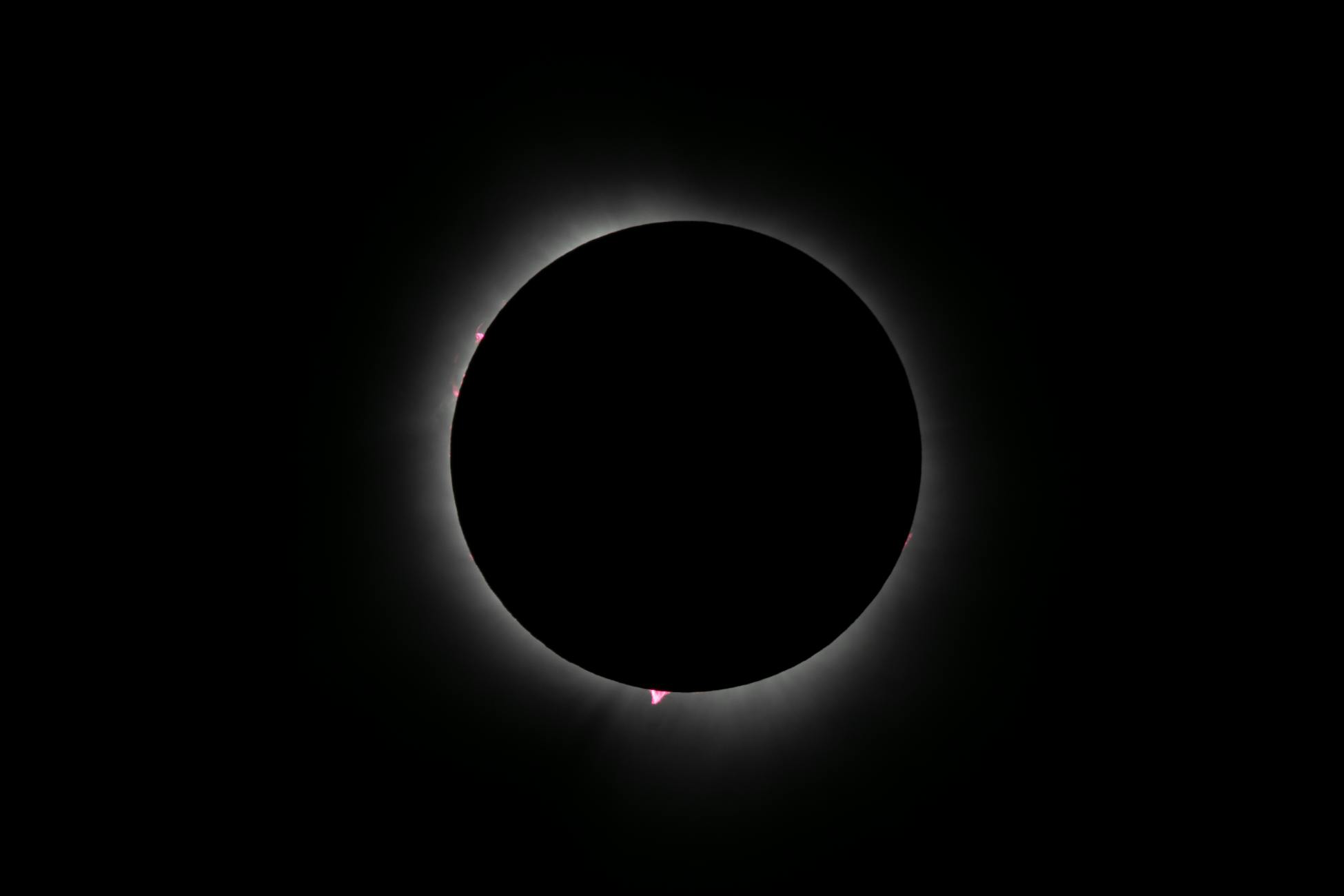
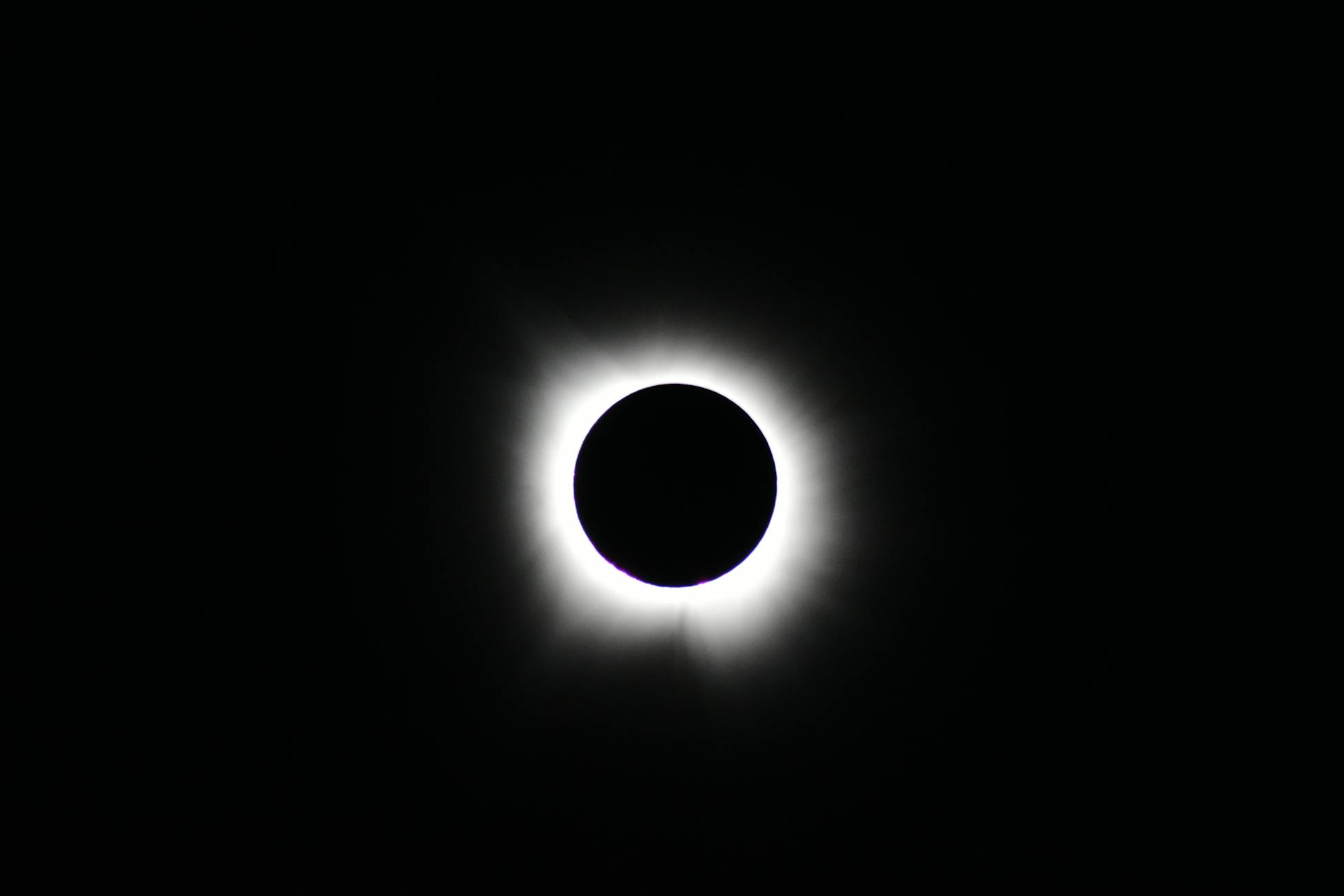
But the direction is settled. Past a certain orbital distance, the Moon’s apparent disc will be permanently smaller than the Sun’s, and every solar eclipse from that point forward will be annular. Whatever observers exist on Earth in that era — biological, machine, or something we have no word for — will see a black coin slide across a brighter coin and leave a ring of fire. They will not see the corona unfurl against a darkened sky. They will not see Baily’s beads. They will not see the diamond ring effect at second contact. Those phenomena require the Moon’s disc to just barely exceed the Sun’s, and that condition will have expired.
What totality actually is, in physical terms
The reason this matters beyond aesthetics is that totality is the only naturally occurring condition under which the Sun’s corona is visible from Earth’s surface without specialised instruments. The corona is the outer atmosphere of the Sun — a region of plasma at over a million degrees Celsius, structured by magnetic fields, that is the source of the solar wind and the seed environment for the space weather that shapes the heliosphere. It is normally drowned out by the photosphere, which is roughly a million times brighter. Block the photosphere precisely — which is what a total eclipse does — and the corona becomes naked-eye visible for the duration of totality.
Eclipse expeditions have been a source of solar physics data for more than a century. Helium was first identified in the Sun’s spectrum during an 1868 eclipse. The 1919 eclipse provided the first observational test of general relativity, when starlight bending around the Sun was measured against the background sky. Modern coronagraphs replicate the geometry artificially with occulting discs in space-based instruments, but the natural geometry remains scientifically useful and culturally singular. Observations of eclipse response suggest that the rarity is doing as much work as the spectacle in producing reactions disproportionate to the visual content itself.
The Artemis II crew, and the view from outside
The geometry that makes terrestrial eclipses possible is specific to standing on Earth’s surface. The Artemis II crew, on their April 2026 lunar flyby, observed a total solar eclipse from a different vantage entirely — passing through the Moon’s shadow in deep space, with Earth visible behind them. The crew described the view as “unreal,” and the mission set a new distance record for human spaceflight, surpassing Apollo 13’s 1970 mark. Reports from the mission noted that the crew also witnessed Earthrise and Earthset on the same trajectory — phenomena that are also functions of being in the right place at the right time, on a mission timed deliberately to thread that geometry. The spacecraft reached a maximum distance of 252,756 miles from Earth, with the crew returning home emphasizing the profound perspective gained from viewing the planet from deep space.
From orbit or cislunar space, eclipse-like events will continue to be observable indefinitely — they are just a matter of being inside a shadow cone. What expires is the specific configuration in which Earth’s surface sits inside the Moon’s umbral shadow with the Sun fully occluded and the corona visible against a dark sky. That is the geometry on the clock.
Temporal scarcity, and its effect on value
The 600-million-year figure is so far outside human temporal intuition that it tends to read as “effectively forever” — which is part of why the framing of this article runs against the grain. The point is not that the next eclipse is the last; the point is that totality belongs to a finite epoch. Every total solar eclipse anyone has ever witnessed, from prehistoric observers to the 2024 North American path of totality, occurred inside that window. So will every one for the next several hundred million years. After that, the phenomenon ends.
The perception that something is running out, even on a scale that does not personally threaten the observer, tends to shift how the thing is valued. The Moon’s recession is the longest-running scarcity clock most people will ever encounter. It is also one of the few cosmic timescales where the direction is known with precision and the endpoint is calculable.
The recession as background condition
In popular coverage, the 3.8 cm figure usually appears as a piece of trivia — a fact mentioned in passing in articles about laser ranging, or buried in explainers about why the days are getting longer. The connection to eclipse geometry is rarely made explicit, and the implication that totality is a temporary feature of being human on this planet even less so. The numbers sit alongside each other without anyone doing the multiplication.
They are worth doing the multiplication on. 3.8 centimetres per year, compounded across hundreds of millions of years, is the slow erasure of a coincidence. Every eclipse path that crosses Earth’s surface in the coming decades — the 2027 totality across North Africa, the 2044 path across Greenland and northern Canada, the long-duration 2027 event over Egypt — is occurring inside a window that, on the scale of the planet’s biography, is closing. The window will not close in the lifetimes of anyone alive today, or their immediate descendants. But the closing is already underway, measured one credit-card-edge at a time, by lasers fired at mirrors that astronauts left behind specifically to track the Moon’s departure.
