
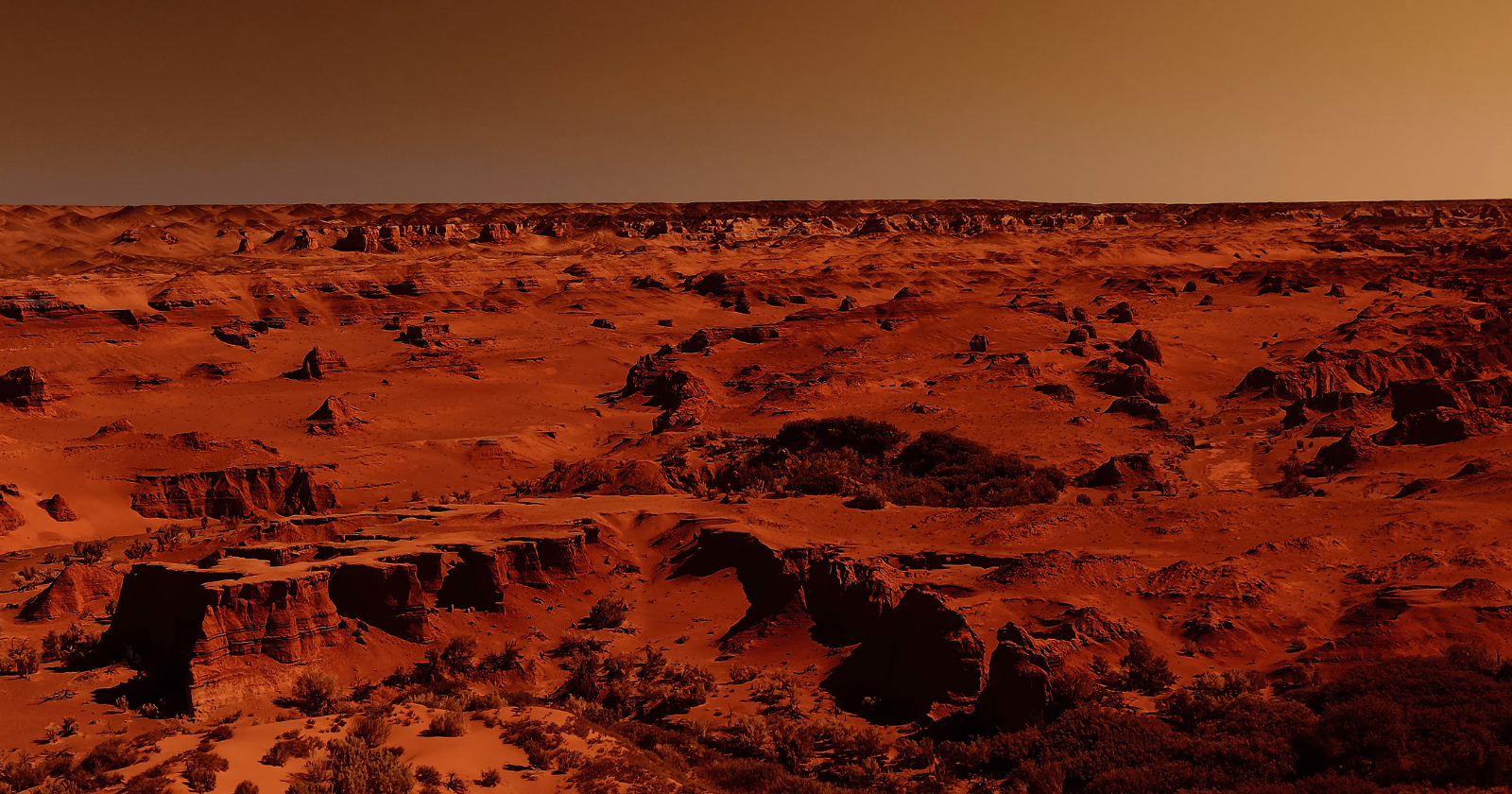
NASA’s Perseverance rover has driven close to 42 kilometres on the surface of Mars. The marathon distance, officially measured at 42.195 kilometres, is now within reach.
For a Mars rover, 42 kilometres is a respectable but not heroic figure. The current distance record on another planet belongs to NASA’s Opportunity rover, which managed 45.16 kilometres over roughly fourteen years before a global dust storm ended its mission in 2018. Perseverance is now within a few kilometres of overtaking it.
The slow pace is the point. Perseverance is not a long-distance vehicle. It is a sample-collecting science platform with six wheels. Driving is interrupted by drilling, abrasion, panoramic imaging and calibration.
It recently completed work on a rocky outcrop called Arethusa, grinding away the weathered surface with its abrasion tool to expose fresher rock underneath. In its 12 May 2026 release, JPL reported that the Arethusa material is composed of igneous minerals that likely predate the formation of Jezero Crater. Ken Farley, the mission’s deputy project scientist at Caltech, said in the same release that the surrounding exposures are “excellent exposure of likely the oldest rocks we are going to investigate during this mission.”
Perseverance was originally certified to drive 20 kilometres. By the time it had covered that distance it had not yet left Jezero Crater. Steve Lee, deputy project manager at NASA’s Jet Propulsion Laboratory, told reporters at the American Geophysical Union meeting in December 2025 that engineering tests over the summer cleared the rotary actuators in the rover’s wheels to drive another 60 kilometres on top of what they had already done. The 100-kilometre cap, Lee said, “just turned out to add up to a nice even” number. Space.com reported the briefing in detail.
Perseverance is also the front half of a plan that has not entirely come together.
In 2023, the rover deposited ten sample tubes on the floor of Jezero for a future mission to collect and return to Earth. That future mission, NASA’s Mars Sample Return programme, has been through repeated review and cost-restructuring, and its schedule and architecture remain unsettled. According to the December 2025 briefing, the Perseverance team is now planning rover operations through most of 2028 with no current plans to deposit additional sample tubes beyond those already waiting.
The rover carries six unused tubes and two collected ones, which can still be replaced if more compelling targets emerge further out. A paper published in Science on 17 December 2025, led by Ken Williford of the Blue Marble Space Institute of Science, reported that samples from Jezero’s “Margin Unit” contain olivine that interacted with water and carbon dioxide to form carbonate minerals. Those carbonates are useful both as records of early Martian conditions and as the kind of mineral that can preserve biological signatures, if any are there to find.
The immediate milestone is the marathon, which the rover should cross during the current driving campaign. After that, the next likely destination is an area the team has named Gardevarri, where olivine deposits have already been identified at the surface. The aim, by the team’s read, is to compare those rocks against the ones gathered from the Margin Unit.
A NASA subsystem assessment cited at the December briefing estimates that Perseverance could keep operating into 2031, limited mostly by the gradual decay of its plutonium power source. The wheels could comfortably travel a total of 100 kilometres. Whether the rover gets there, and whether the rocks it has picked up along the way ever come home, are the two open questions the marathon does not answer.
