
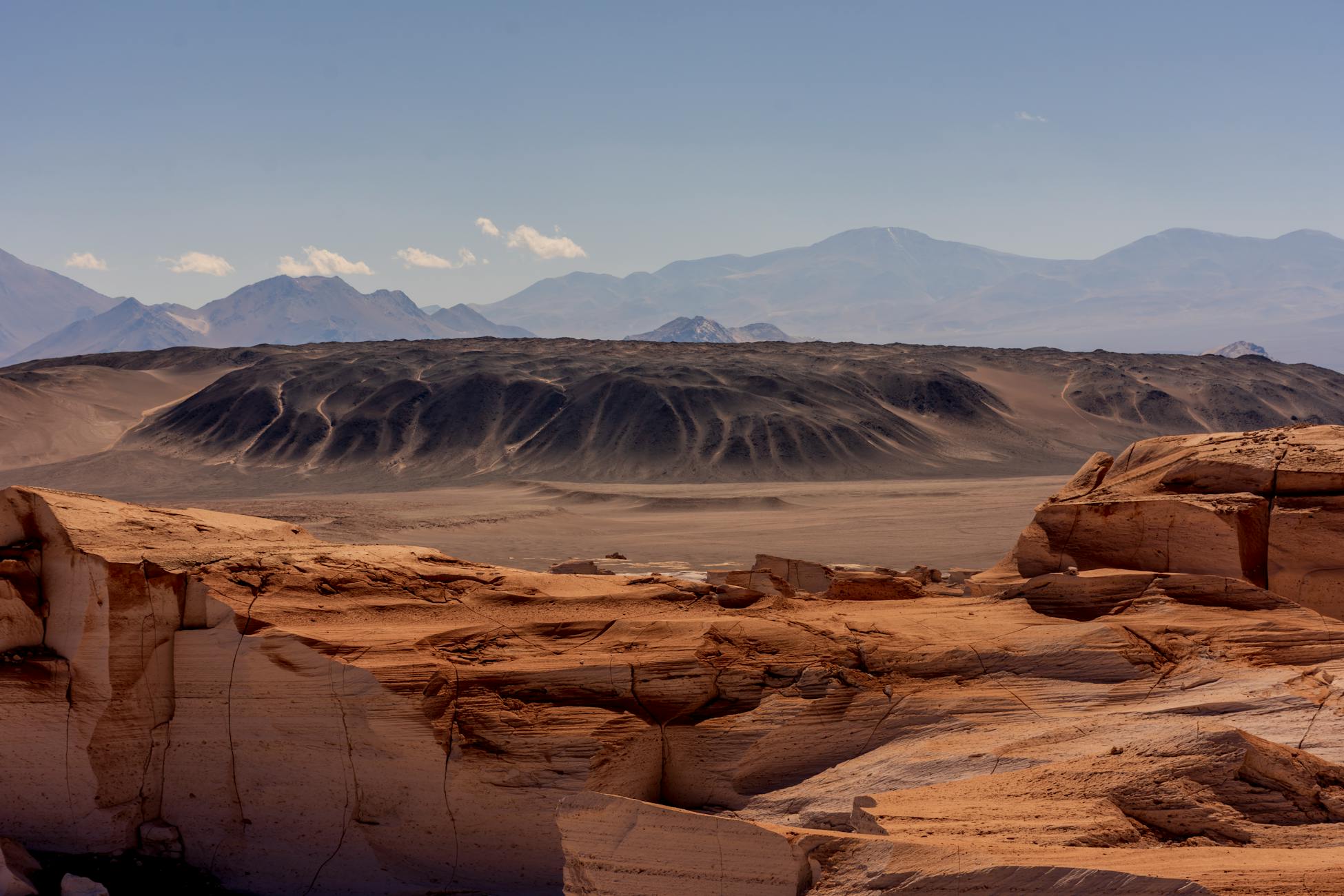
The Atacama Desert has long been useful to planetary scientists for a simple reason: it is not Mars, but it fails in some of the same ways Mars fails. It is dry, salty, exposed, uneven, and biologically difficult. In places, life is present only faintly enough that instruments have to work hard to find it.
That is why a recent finding from the desert’s subsurface matters. Researchers studying one of the driest parts of northern Chile reported that viable microbes were detected down to 4.2 metres below the surface, using a molecular method designed to focus on DNA from intact, living or dormant cells rather than loose genetic fragments left behind by dead organisms.
The discovery does not mean that Mars has life. It does not mean that Atacama microbes are alien, or even alien-like in their chemistry. They are terrestrial organisms, descended from the same biological history as everything else on Earth.
What it does show is more useful and more cautious: life can persist in a place that sits close to the dry, salty, low-biomass edge of habitability. For scientists trying to work out how to search for life beyond Earth, that edge is where the real problem begins.
What the Atacama study actually found
The research team examined a soil profile in the Yungay area of the Atacama Desert, about 60 kilometres southeast of Antofagasta. Samples were taken down through playa sediments and into older alluvial deposits beneath them, reaching a depth of 4.2 metres.
The important part was not simply that DNA was recovered. Soil can preserve genetic material long after an organism has died, especially in environments where decomposition is slow. That makes it easy to mistake old biological traces for living communities.
To reduce that problem, the researchers used a method that separates extracellular DNA, which can come from dead cells, from intracellular DNA, which is contained inside intact cells. That distinction matters in a desert where biomass is extremely low and the difference between life, dormancy, and biological residue is easy to blur.
The results showed potentially viable microbial communities at depth. In the upper 80 centimetres, the team found communities dominated mainly by Firmicutes. Below two metres, they identified a different and more diverse community, dominated by Actinobacteriota, in alluvial fan deposits that appeared isolated from the surface.
That layering is the real signal. A sterile environment would not be expected to produce structured, depth-specific communities. The finding suggests that the subsurface is not merely storing dead traces from a wetter past. At least some of it appears to be a habitat, however slow, sparse, and difficult that habitat may be.
Why this matters for Mars
The Atacama Desert is often described as Mars-like, but that phrase needs care. Earth’s driest hot desert is still part of Earth. It has oxygen, a biosphere, a long history of terrestrial contamination, and environmental conditions that are not identical to the Martian surface.
Its value is more practical than poetic. The Atacama gives mission scientists a place where biology is hard to detect, unevenly distributed, and shaped by harsh chemistry. That makes it useful for testing how instruments search for faint signs of life.
In earlier Mars-analog work, a rover-mounted robotic drill was deployed in the Atacama to test whether it could recover subsurface samples in an environment used as a stand-in for some Martian conditions. The samples contained scattered, salt-resistant microbes, and the researchers argued that life in extreme environments can be patchy enough that robotic search strategies have to account for that patchiness.
That is the central lesson for Mars. A rover might not fail because biology is absent. It might fail because biology, if it exists, is sparse, buried, chemically masked, or present only in particular niches. The Atacama helps scientists rehearse that uncertainty before a mission has to deal with it millions of kilometres away.
The 2024 subsurface finding sharpens the point. If microbes can persist metres beneath one of Earth’s most hostile deserts, then the search for life on Mars cannot be designed only around what sits at the surface. Radiation, temperature swings, oxidizing chemistry, and long periods without accessible water make the Martian surface hostile. Subsurface refuges remain the more plausible place to look.
The gypsum clue
One of the more intriguing parts of the Atacama study is the possible role of gypsum. The deeper microbial community was associated with gypseous substrates, and the researchers suggested that gypsum could provide an alternative source of water in an otherwise hyperarid setting.
That matters because gypsum has also been found on Mars. The comparison should not be overstated. A mineral that helps explain a possible microbial niche on Earth does not prove that the same niche exists on Mars. But it gives astrobiologists a more precise question to ask.
Instead of asking whether life can survive “in a desert,” the better question becomes whether certain minerals can create small, protected, chemically useful habitats inside otherwise punishing environments. That is a more testable question, and it is exactly the kind of question Mars missions are built to refine.
The Atacama does not provide a preview of Martian life. It provides a training ground for recognizing weak biological signals in hostile material.
The contamination problem runs the other way too
There is another reason Atacama-style research matters: planetary protection. If spacecraft are sent to worlds where life might exist, mission planners have to reduce the risk of sending Earth organisms along for the ride.
That risk is not theoretical. Smithsonian Magazine reported on a fungus recovered from NASA cleanrooms that showed striking resilience under harsh testing, including conditions related to space travel and Mars-like stress.
The overlap is uncomfortable. The traits that allow organisms to survive in extremely dry, salty, nutrient-poor environments are the same kinds of traits that make some organisms hard to eliminate from spacecraft assembly facilities. Slow metabolism, resistance to desiccation, tolerance of radiation or oxidative stress, and durable spores or cell structures are exactly what planetary-protection teams worry about.
This does not mean spacecraft are carrying thriving colonies to Mars. It means the cleanest missions still have to take microbial survival seriously. If a future rover detects a possible biosignature, scientists will have to ask not only whether it is biological, but whether it could be terrestrial contamination, instrument noise, preserved dead material, or a real native signal.
What “analog” really means
Calling the Atacama a Mars analog does not mean it is a replica of Mars. It means specific parts of the environment are useful for specific scientific tests.
The desert is useful because it forces instruments and researchers to deal with ambiguity. Biological signals can be weak. Microbial life can be present in one patch and absent in another. DNA can come from living cells, dormant cells, or dead material. Minerals can preserve or obscure evidence. A sample can look barren until the right method is used.
Those are precisely the problems that a Mars mission would face at higher stakes.
The Atacama also pushes scientists away from a simplistic version of the life-detection question. The problem is not just whether a machine can find a molecule associated with life. The problem is whether several independent lines of evidence can survive scrutiny together: chemistry, geology, morphology, context, contamination control, and repeatability.
That is why a deep microbial community in Chile can matter to Mars without making any claim that Mars is inhabited. The value is methodological. It helps researchers understand what faint life looks like, how easily it can be missed, and how carefully a positive signal would need to be checked.
The claim is narrower, and stronger, than the headline version
The most tempting version of this story is also the least careful one: life found in the Atacama proves life could survive on Mars. The science does not go that far.
A stronger reading is narrower. Researchers found potentially viable microbial communities deep beneath one of Earth’s driest hot deserts. Those communities appear structured by depth, chemistry, and mineral context. Some of the same environmental pressures that make the Atacama difficult for life are relevant to the search for life on Mars. That makes the desert a valuable analog for testing methods, not a substitute for Martian evidence.
The difference matters. Astrobiology advances by resisting the easy leap. A gram of soil, a drill core, or a DNA sequence can be suggestive, but the larger question remains open until samples from Mars are studied under conditions that can rule out the ordinary explanations first.
For now, the Atacama’s message is not that Mars is alive. It is that life on Earth can persist closer to the edge than old assumptions allowed, and that the search for life elsewhere has to be built for a world where the signal may be buried, patchy, and almost silent.
