
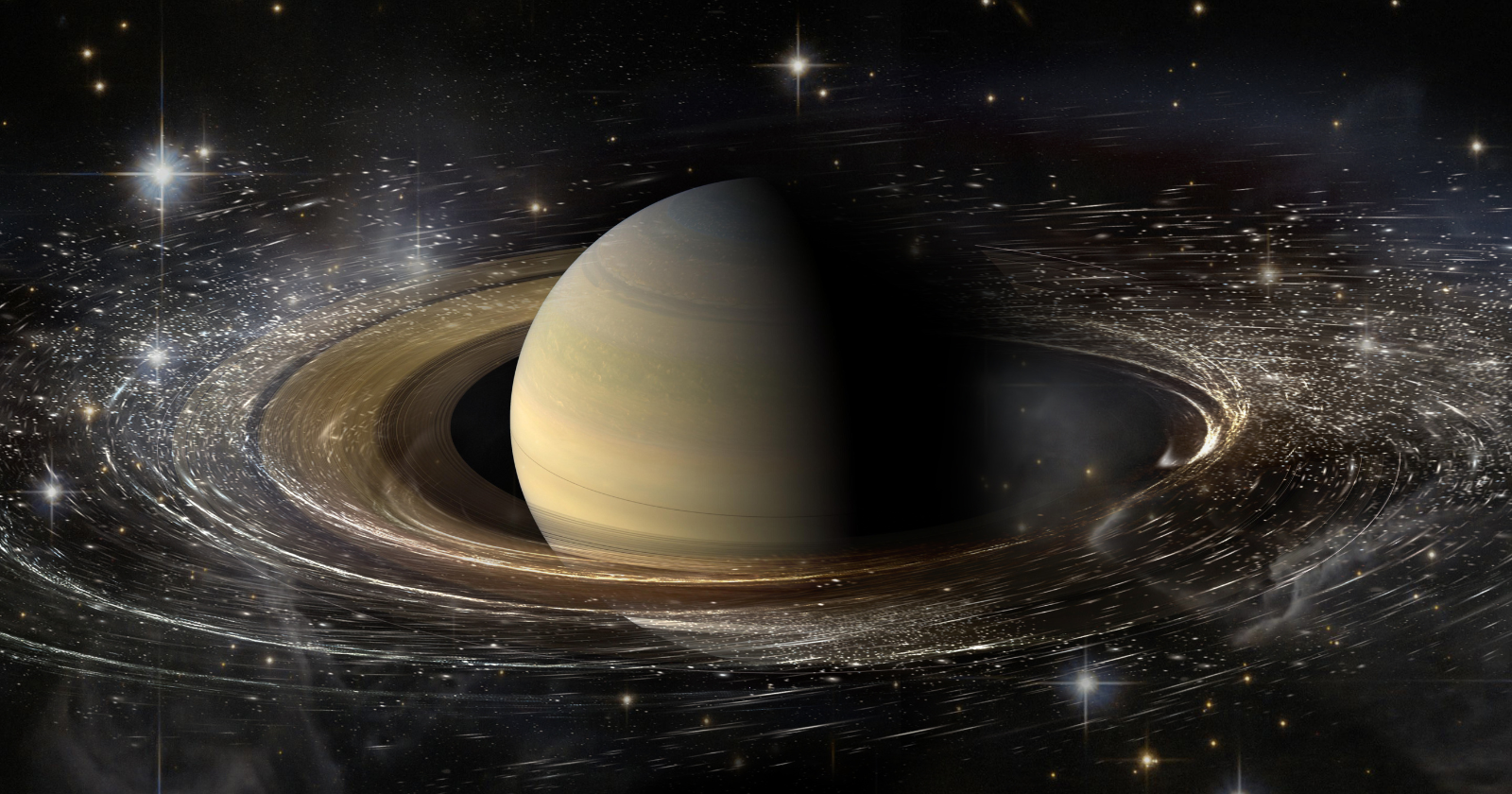
The figure most people remember from the 2018 ring rain study is the Olympic swimming pool. Saturn, according to the team led by James O’Donoghue of NASA’s Goddard Space Flight Center, loses an amount of water from its rings every half hour that would fill one. At that rate the rings have a finite shelf life. The paper, published in Icarus on 17 December 2018, put the ceiling at roughly 300 million years from ring rain alone. Add in the additional ring material the Cassini spacecraft observed falling directly onto Saturn’s equator, and the timeline shortens. O’Donoghue’s stated figure: less than 100 million years.
That is the number that has travelled. It is also the more dramatic end of the estimate, and the one most often quoted without its companions.
What the ring rain paper actually showed
Ring rain is not a metaphor. Electrically charged ice particles from the rings are pulled along Saturn’s magnetic field lines into the planet’s upper atmosphere, where they vaporise and react with the ionosphere. The mechanism was first proposed in the 1980s on the basis of Voyager data by Jack Connerney, who is a co-author on the 2018 paper. O’Donoghue’s team observed the effect directly using infrared instruments at the Keck telescope on Mauna Kea, looking for the glow of charged H3+ ions. They found bands of glow at the latitudes where the ring particles should arrive if the proposed mechanism were correct, and the amount of rain matched the high end of estimates Connerney and colleagues had made three decades earlier.
The headline figure of 100 million years is a worst-case projection. As the NASA release notes, ring rain alone gives roughly 300 million years. The shorter figure depends on combining ring rain with the equatorial infall Cassini measured during its final orbits in 2017. Both figures assume current rates hold steady, which on the available evidence they may not. Ring rain depends on solar ultraviolet light charging the ice particles, and the rate likely varies with Saturn’s 29.4-year orbital cycle as different parts of the ring system are illuminated.
None of which makes the rings permanent. It does mean the disappearance number is a range, not a date.
Why the rings also looked young
The “lucky to see them” framing rests on a second finding, distinct from the ring rain work. In its final orbits, Cassini dove 22 times between Saturn and its inner rings, allowing a team led by Luciano Iess at Sapienza University in Rome to measure the gravitational tug of the rings independently of the planet. The ring mass came in low. The team published its analysis in Science on 17 January 2019, with an inferred ring age of 10 to 100 million years.
The logic runs as follows. Saturn’s rings are unusually clean, more than 95 per cent water ice, with very little of the dark interplanetary dust that should accumulate over hundreds of millions of years of bombardment. A low total ring mass, on this argument, means the rings haven’t had time to be contaminated. NASA’s JPL release on the study put the comparison in plain terms: if the rings are 10 to 100 million years old, they may have formed during the age of dinosaurs. A 2023 paper in Science Advances by Sascha Kempf and colleagues, using Cassini‘s Cosmic Dust Analyzer to measure the actual rate of micrometeoroid infall, supported this picture, putting an upper bound on the rings of a few hundred million years.
Combined with the disappearance timeline, this is what produces the “brief window” claim. A 4.5-billion-year-old planet, a ring system that may have arrived only in the last few hundred million years, and a drainage mechanism that will empty it on roughly the same timescale.
The contesting view
The age side of this picture is genuinely unsettled. A paper by Ryuki Hyodo and colleagues, published in Nature Geoscience in December 2024, proposed that the inference from low pollution to young rings does not hold the way the earlier work assumed. Their argument, on a careful read, is that ring particles may be more resistant to incorporating micrometeoroid material than the standard model allows, because much of the impactor debris is ejected from the system rather than retained. If that is right, the rings could appear clean while being far older, potentially as old as Saturn itself. An earlier Nature Astronomy commentary by Aurélien Crida and co-authors had already flagged the young-rings interpretation as one possibility among several.
This is not a settled debate. It is a live one, with serious groups on either side, and the question of how to date a ring system from physical properties rather than direct observation is harder than the headlines have generally implied.
What the framing is worth
The ring rain measurement is solid. The disappearance timescale, allowing for the range from 100 to 300 million years and the caveat about seasonal variation, is a reasonable upper estimate of how long the present ring system can last under current conditions. The young-rings half of the story is less secure. If the rings are ancient, then we are not living through a brief window so much as a late one, and earlier observers on a hypothetical Earth could in principle have seen the rings too.
What we keep coming back to in our reading is how much of the “we are lucky to be alive now” framing rests on a single line of inference that is currently under revision. The disappearance figure has stood up. The young-rings figure may not. Whether the window is brief or long depends on which paper holds up over the next decade.
The next observational test is unlikely to come from a dedicated Saturn mission any time soon. Cassini‘s final orbits were the last close passes through the inner ring region, and there is no funded successor mission. The constraints will come instead from continued reanalysis of Cassini data, ground and space telescope observations of ring composition, and the laboratory and modelling work on how impacts and particles actually interact. The disappearance is on schedule. The age remains an argument.
