
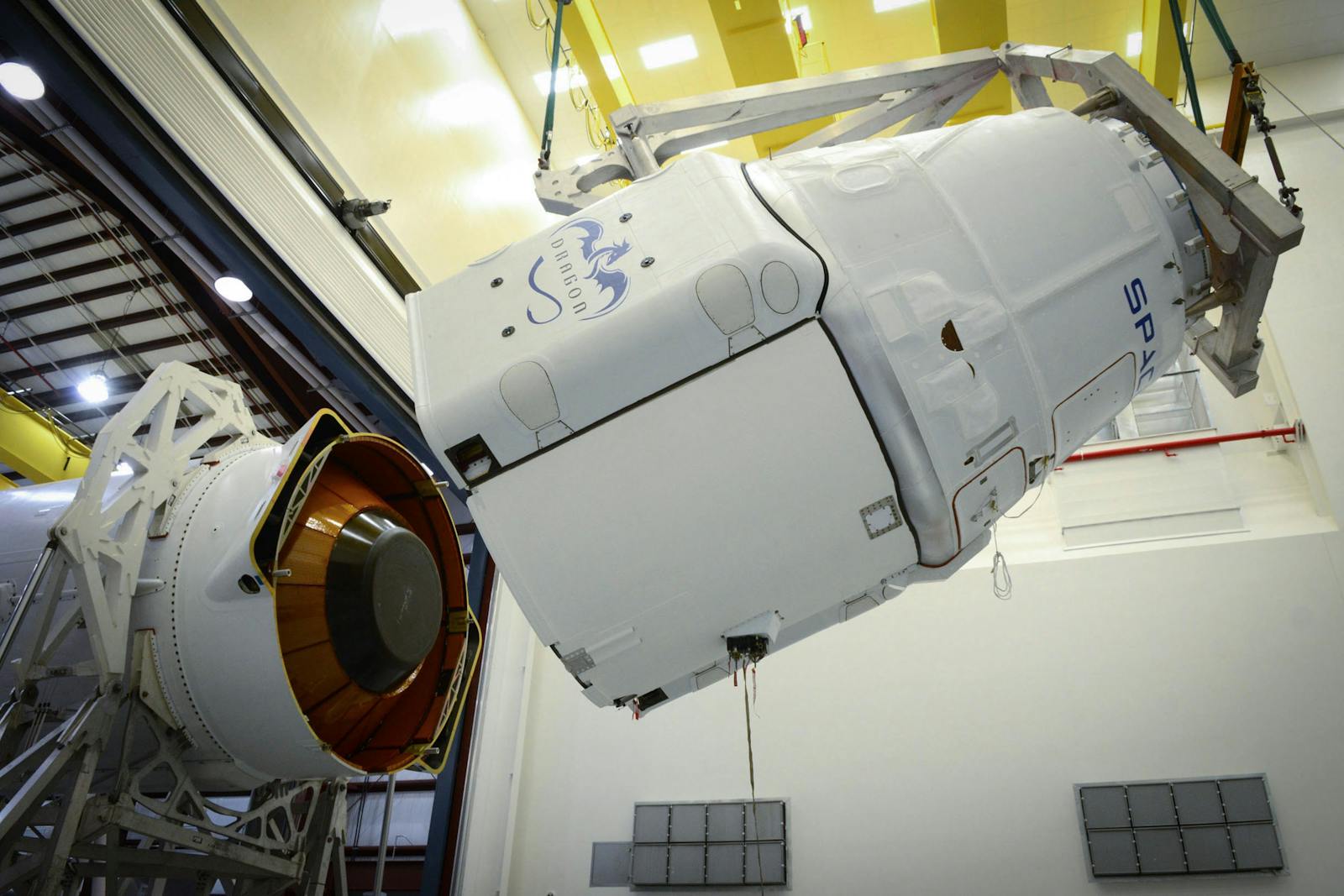
SpaceX launched its 34th cargo resupply mission to the International Space Station on May 15, and the Dragon capsule on top of the Falcon 9 was flying its sixth trip to orbit. A few years ago, that would have been a headline. This time it barely registered. The quiet reception is itself the story: reuse has become so routine that the milestones blur into operational background noise, and the economics of station resupply have been rewritten without much public notice.
The Falcon 9 lifted off from Space Launch Complex 40 at Cape Canaveral Space Force Station at 6:05 p.m. Eastern, according to SpaceNews, after two earlier attempts were scrubbed. Weather concerns postponed an earlier attempt, and another countdown was halted in its final minute when launch weather criteria were violated.
Dragon separated from the upper stage roughly 10 minutes after liftoff. Docking with the station’s Harmony module is set for approximately 7 a.m. Eastern on May 17.

A sixth flight, and what it means
The capsule flying CRS-34 first reached the station in 2021. Five years and six missions later, it has become the first cargo Dragon to match the reuse record previously set only by SpaceX’s astronaut-carrying Endeavour capsule, as Space.com reported. The Falcon 9 booster that carried it also notched its sixth flight and sixth landing, returning to Cape Canaveral about seven and a half minutes after liftoff. A six-flight booster paired with a six-flight capsule on the same mission would have been treated as historic a few years ago. Now it is a Friday.
The certification work to allow a sixth cargo flight was largely inherited from the human-rated program. SpaceX mission management said at a pre-launch briefing that the company had already done most of the certification work when qualifying Crew Dragon for six flights. For this flight, it was essentially a delta certification, looking at the hardware items that are unique to the cargo configuration.
That detail matters more than it sounds. Cargo and crew variants share a structural lineage, so certification efficiencies on one side compound on the other. The pattern is exactly what NASA hoped for when it bet on commercial providers a decade ago, and it stands in sharp contrast to the parallel Boeing program that has not delivered the same flexibility. Space Daily has previously examined how the divergent fortunes of those two contracts traces back to a single day in 2014.
Why normalization is the milestone
When reuse becomes invisible, it has succeeded. The ISS resupply program, born from the post-Shuttle scramble to keep the station fed by American rockets, has quietly produced a hardware portfolio where individual capsules and boosters accumulate flight history the way airliners accumulate cycles. The economics of that shift are not in any single launch contract but in the absence of a story around each new flight. Hardware that was once treated as expendable now flies, lands, refurbishes, and flies again, and the agency planning the manifest assumes it will keep doing so.
That assumption shows up in how NASA is using the remaining time on the station. The ISS is on a glide path toward retirement near 2030, and NASA’s deputy chief scientist for the ISS program said at a pre-launch briefing that the manifest reflects a sharpening focus rather than a wind-down. The research on the station as it nears retirement shows a finer resolution and focus on the work being done there. The pressurized cargo on CRS-34 reflects that posture: experiments to determine how well ground-based simulators reproduce microgravity, a bone scaffold built from wood that could inform osteoporosis treatments, and a study of how red blood cells and the spleen change in space. An external payload called Space Test Program-Houston 11, a joint NASA and U.S. Space Force effort, carries STORIE, an instrument designed to study charged particles in orbit.
What routine reuse actually buys you
The concrete payoff of all this normalized reuse is sitting on the schedule for mid-June, when CRS-34 undocks and splashes down off the California coast. Dragon remains the only operational ISS resupply ship capable of returning cargo to Earth intact. Progress, Cygnus and HTV-X are all designed to burn up on reentry. The capsule coming home will carry time-sensitive research, the kind of downmass capability that becomes harder to replace as the station nears the end of its life and commercial successors remain on paper.
That downmass channel exists because the same capsule can be flown, recovered, refurbished and flown again without the program treating each cycle as a special event. A fleet that flies six times per vehicle is a fleet that can absorb the wear of reentry, splashdown and recovery as a normal cost of doing business rather than a reason to throw the hardware away. The headline on CRS-34 is not the sixth flight. It is that the sixth flight was uneventful enough to ignore.
