
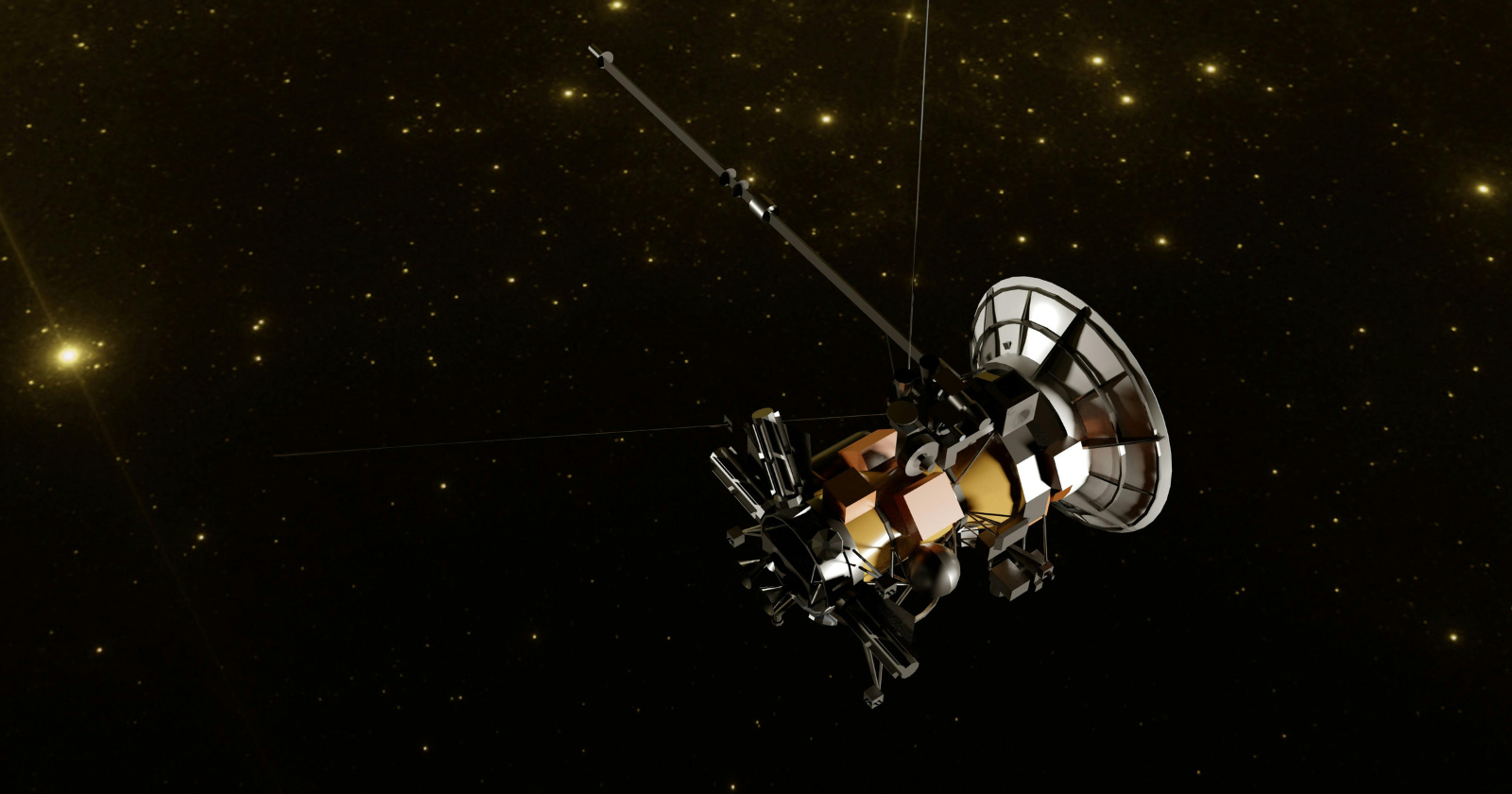
The popular version of this story has hardened into a fixed shape. NASA still runs the Voyagers on software written in a programming language nobody alive can read, kept going by a handful of engineers all in their eighties, with no one queued up to replace them.
In our reading of the record, parts of this are accurate. Parts are not. The underlying problem is real, and more specific than the headline suggests.
What the spacecraft actually run
The Voyager onboard computers run assembly language written for purpose-built General Electric interrupt-driven processors, designed and fabricated in the early 1970s. Three computer systems sit on each spacecraft: the Computer Command Subsystem, the Attitude and Articulation Control Subsystem, and the Flight Data Subsystem. The FDS is the one most often in the news, because it packages science and engineering data for transmission and was the subsystem at the centre of Voyager 1’s five-month communications failure in late 2023 and early 2024.
The popular shorthand often says Voyager “runs on Fortran.” That appears to blur two things: onboard flight software and ground-side tools. The spacecraft’s low-level flight work depends on assembly-language programming on highly specialised hardware. Fortran has been associated with ground systems and older mission tooling. When NASA went looking for a replacement engineer in 2015, the brief covered both, but Suzy Dodd’s specific concern in the same coverage was finding people who could program in assembly and understand the intricacies of the spacecraft.
The spacecraft’s onboard computing resources are tiny by modern standards. Across the Voyager computer systems, the total memory is often described as roughly 64 to 70 kilobytes, less than the size of a small image file today. Dodd has compared operating it to flying an Apple II. The comparison captures the basic point: the team is operating a deep-space probe with computing resources from another technological era.
What was lost, and when
Forty-nine years of operations have produced gaps that matter more than the language itself.
Around the start of the interstellar mission, after Voyager 2’s closest approach to Neptune in August 1989, the flight software was updated to make each spacecraft more autonomous and better suited to long-term operations with less hands-on attention from Earth. That version, augmented by command sequences the team uploads every few months, is the basis of what is running now.
The team has shrunk and aged across decades. More significantly, much of the original documentation has been lost or fragmented. Voyager paperwork from the 1970s and 1980s was largely paper, and each time the project moved offices, more of it disappeared. Dodd told Live Science in early 2024 that “the people that built the spacecraft are not alive anymore,” and that although the team has a “reasonably good set of documentation,” much of it is still on paper, making the search for records feel like “this archaeology dig to get documents.”
The Zottarelli retirement, in context
Larry Zottarelli was the last original Voyager engineer still working on the project when he retired in 2016, at 80. He had been with the mission since launch in 1977 and worked on the Flight Data Subsystem. CNN, Popular Mechanics and others reported the retirement at the time as a moment of generational transition. The framing that “the engineers who understand the code are in their 80s” comes mostly from this period.
It is now nine years out of date.
The current Voyager flight team is a small group of engineers at JPL, most of them not in their 80s. Dodd herself was 16 when Voyager launched. She first worked on the spacecraft in 1984 as a sequence designer for the Uranus encounter, returned as project manager in 2010, and has been in the role since. The flight engineering work has been handed over, more than once, to people who were not on the original team.
The harder problem
What Dodd has flagged publicly is more specific than a generational story. The underlying difficulty is finding engineers who can program assembly fluently on custom hardware, who are willing to work on a mission with a defined endpoint, and who have the patience for the documentation gaps. Fluency in assembly is no longer routine training. In Dodd’s framing, younger engineers often have the capability but not the inclination.
The team also leans on a list of retired engineers it can call in emergencies. That list is shorter every year.
This is the real version of the story. Not that the code is unreadable, but that the institutional memory around the code is fragmentary, and the conditions that produced the engineers who built it cannot be reproduced.
What to watch next
The hardware is on a slow decline. The radioisotope thermoelectric generators lose about four watts of electrical output per year, and JPL has been turning instruments off one at a time to keep both spacecraft alive. According to NASA’s Voyager FAQ, engineering data could continue to return for several years after science data stops, and the spacecraft may remain within Deep Space Network range until around 2036, depending on available transmit power. The 50th anniversary of launch falls in September 2027, which is the next public milestone Dodd has flagged.
The succession problem matters most in the next decade. After that, the question becomes academic. There will be no Voyagers left to maintain.
