
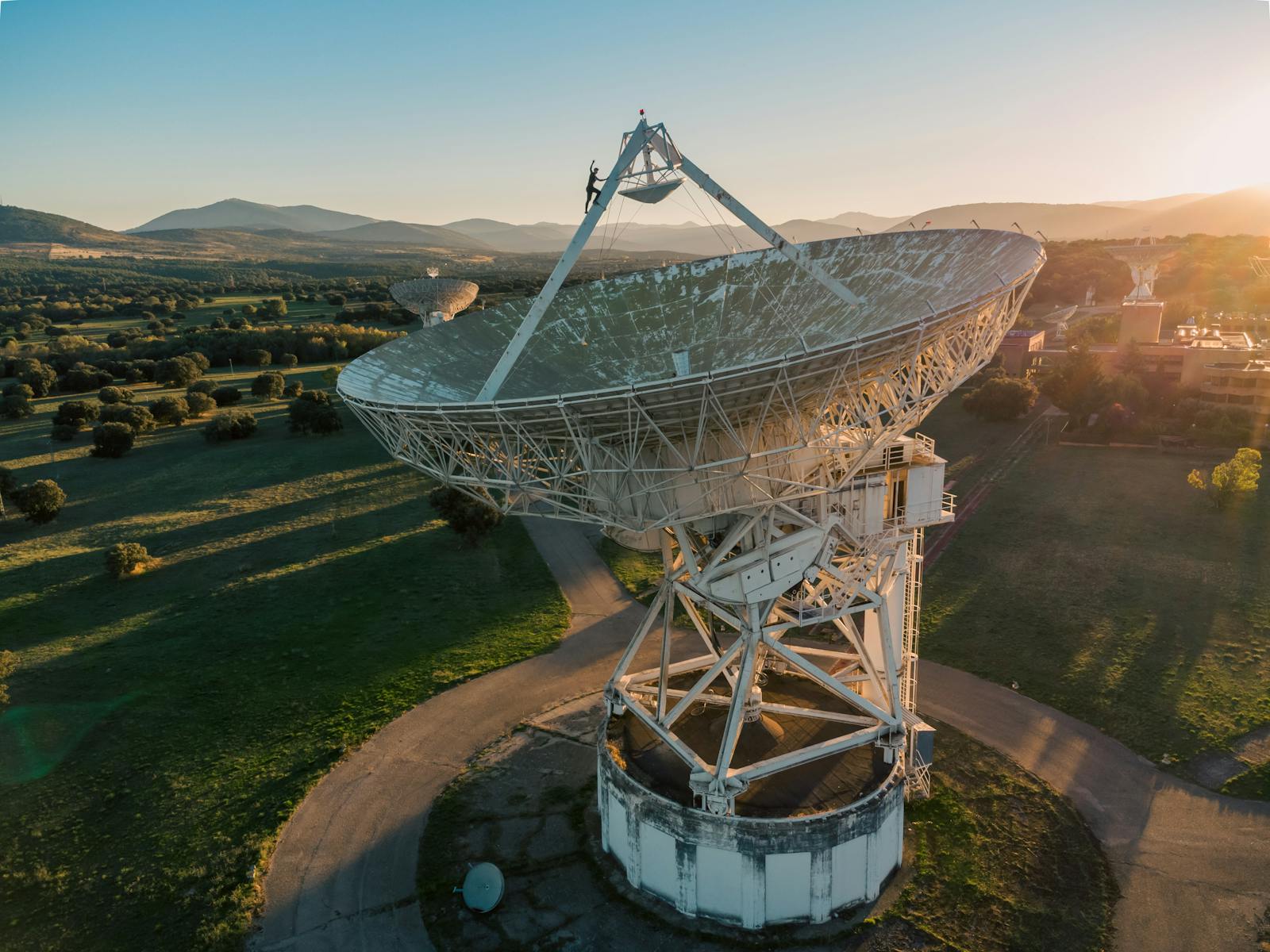
On the same week NASA opened bidding on its eighth Commercial Lunar Payload Services task order, the Houston-based lander company Intuitive Machines announced it was buying Goonhilly Earth Station Ltd. and its American subsidiary Comsat for £37 million, or roughly $49.6 million. The acquisition brings under one corporate roof a pair of 30- and 32-meter antennas on the Cornish coast, plus teleports in Connecticut and California with dozens of additional dishes.
The strategic logic is plain enough. Intuitive Machines wants to be the prime contractor for a lunar communications and navigation network, layering its planned lunar-orbit relay satellites on top of an Earth-side ground segment it no longer has to rent. Combined with its acquisition of Lanteris Space Systems — the former Maxar production capabilities that will let it build landers at higher cadence — the company is assembling the architecture of a vertically integrated cislunar utility.
The irony is that the company has not yet landed a spacecraft on its feet. Both of its lunar landers, Odysseus in February 2024 and Athena in March 2025, tipped over on touchdown. The third attempt is still ahead. The ground-station deal is being struck by a firm whose flight record on the Moon is, charitably, partial.
The numbers that sit alongside each other
Two facts deserve to be placed next to each other without rhetorical scaffolding. The first: Intuitive Machines is paying $49.6 million to bring a global ground-station network in-house, integrating it into a planned lunar communications architecture for which the company is also bidding follow-on NASA work. The second, documented by Aerospace America, is that of the four robotic landers flown under CLPS through mid-2025, only Firefly Aerospace’s Blue Ghost completed its mission upright and intact. Intuitive Machines is responsible for two of the three that did not.
This is not an indictment. Fixed-price commercial contracting was designed by NASA precisely to accept a higher tolerance for failure in exchange for lower unit cost and faster iteration. Tipping over is not, by the program’s own logic, disqualifying. The Athena mission returned useful data; Odysseus transmitted from the surface. Neither was a total loss.
But the sequencing is worth examining on its own terms. A firm with a one-in-two soft-landing record is acquiring strategic infrastructure faster than it is accumulating clean landings. The structural question is not whether the company should be allowed to do this — it should, and the M&A is rational corporate behavior — but what it tells us about which capabilities the CLPS framework rewards a contractor for building first.
The thesis: infrastructure capture before engineering mastery
CLPS rewards the accumulation of moats — ground-station ownership, lander production capacity, integrator status with NASA — on a faster clock than it rewards engineering reliability. That is not a hidden feature of the program. It is the explicit theory: subsidize commercial actors through anchor-tenant contracts until a private cislunar economy emerges, and tolerate partial mission success along the way so that firms have runway to build the surrounding business while the underlying craft matures.
The Goonhilly deal makes the shape of that theory visible. Intuitive Machines is buying the option value of being the prime cislunar communications integrator before it has demonstrated the operational reliability that would normally precede such an option. The fixed-price structure, by tolerating two tipped landers, gives the company the standing — and the share price — to do precisely that.
What the technical claim actually amounts to
It is worth being precise about what Intuitive Machines is and is not. The company has flown two missions to the lunar surface, both of which arrived but neither of which remained upright. The IM-2 failure on Athena involved a laser altimeter issue and a landing-site terrain that the spacecraft could not adequately characterize before touchdown. The fixes for the third mission — refined altimetry, revised landing-site selection, modifications to the landing-gear geometry — are credible but unproven. They will be proven, or not, on the next flight.
The communications architecture Intuitive Machines is building toward is even further from operational maturity. The lunar-orbit relay satellites the company plans to deploy under NASA’s Near Space Network Services contract have not yet flown. The integration of Goonhilly’s antennas into a coherent cislunar service offering is, today, a slide rather than a system. The Lanteris production capabilities acquired from Maxar will need to be retooled for lunar lander manufacture at a cadence the company has not yet demonstrated.
None of this is unusual for a commercial space firm at this stage. Prototypes are years from production; acquired capabilities take time to integrate. The honest description is that the company is assembling the business of a cislunar utility in parallel with — not after — proving it can put a spacecraft down on its feet.
What kind of industry this builds
The CLPS contracts pay for delivering NASA science payloads to the lunar surface. The infrastructure being assembled around those contracts — ground stations, lander factories, planned relay constellations — will, if the strategy works, serve a much wider market: Defense Department customers, allied space agencies, commercial lunar prospectors, and whatever cislunar activity emerges in the 2030s. The taxpayer foots a portion of the bill for the early flights; the moats accrue to the firm.
That is a defensible bargain. It may even be the only realistic path to a commercial lunar economy in a budget-constrained NASA. But it is a bargain with a specific shape: the chokepoints of the future cislunar economy are being claimed now, by firms whose engineering ledgers are still being written. Whoever owns the ground segment, the lander production lines, and the relay licenses when the technology finally matures will tend to keep owning them, regardless of which firm builds the most reliable lander in 2027.
It would be easy, and wrong, to conclude that Intuitive Machines is getting ahead of its skis. The company is doing what its incentives instruct it to do. Acquiring Goonhilly is a reasonable move; pursuing the CS-8 task order is a reasonable move; buying the Maxar capabilities was a reasonable move. The board is playing the game the rules permit.
It would be equally easy, and equally wrong, to conclude that the CLPS framework is failing. One in four is a thin record, but the program was not sold to Congress or the public on a promise of four-for-four. It was sold on the promise of cheaper science delivery and the seeding of a commercial industry. By the second metric, the program is succeeding visibly. Firms are raising capital, acquiring infrastructure, and competing for follow-on work.
Back to the $49.6 million
Which returns the analysis to the specific number on the specific deal. $49.6 million is not a large sum in the context of a lunar program; it is roughly the cost of a single CLPS task order. What that sum buys Intuitive Machines is not engineering competence — no acquisition can buy that, and the third landing attempt will demonstrate whether the company has accumulated it internally — but position. Two 30-plus-meter antennas in Cornwall, teleports in Connecticut and California, and a customer book that converts the company overnight from a renter of ground services into a seller of them.
That is the CLPS pattern in a single transaction. The framework is producing an industry in which infrastructure ownership consolidates faster than landing records improve, and in which the firms best positioned to win the cislunar decade are the ones that recognize, as Intuitive Machines plainly has, that the moats are available now and the engineering can be sorted out across the next several flights. Whether the engineering catches up is the question that the third landing, and the ones after it, will answer. The ground stations, by then, will already belong to someone.
