
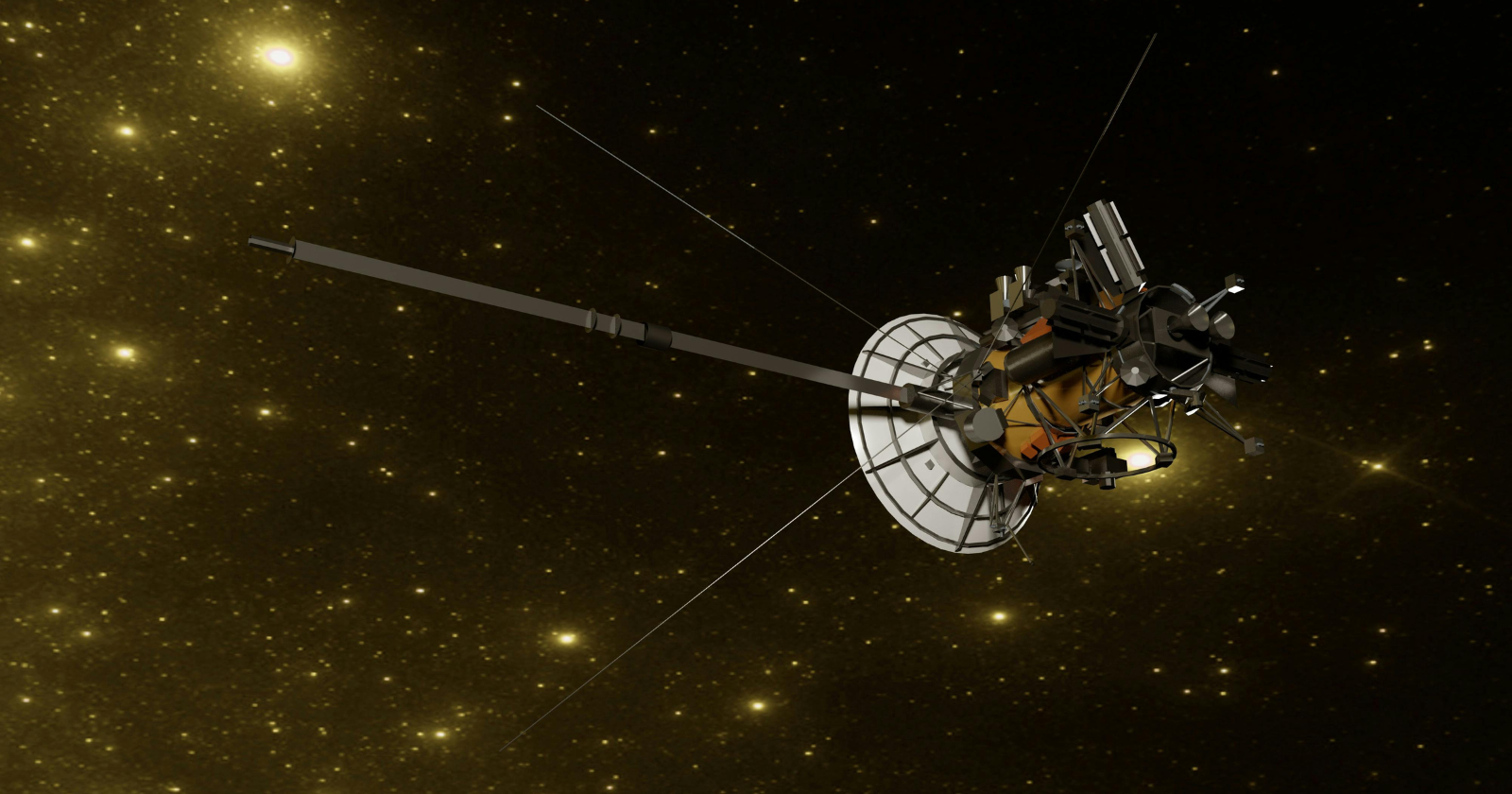
On 17 April 2026, mission engineers at NASA’s Jet Propulsion Laboratory in California sent commands to switch off the Low-energy Charged Particles experiment aboard Voyager 1. The instrument had been operating, almost without interruption, since the spacecraft left Cape Canaveral in September 1977.
The shutdown was not a fault. It was the latest in a careful sequence of sacrifices.
Voyager 1’s three radioisotope thermoelectric generators lose about four watts of electrical output each year as the plutonium-238 inside them decays. After nearly forty-nine years, there is not much margin left. According to the announcement from JPL, switching off the LECP buys the mission roughly another year of operating headroom.
Why this instrument, why now
The immediate trigger was a roll manoeuvre on 27 February 2026, during which Voyager 1’s power readings dropped unexpectedly close to the level that would have activated the spacecraft’s automatic undervoltage fault protection. That protection works by shutting components down on its own terms, not the team’s. The resulting recovery process tends to be lengthy and risky. The Voyager team decided to act before the spacecraft acted for them.
The choice of what to switch off was not improvised. Years ago, the Voyager science and engineering teams agreed on the order in which they would shut systems down to keep the mission alive. Of the ten identical scientific instruments each Voyager originally carried, seven have now been turned off.
The LECP measured low-energy charged particles: ions, electrons, and cosmic rays. In our reading of the published material, what made it valuable was that it was one of the few instruments still returning data from the region of space immediately beyond the heliosphere, where no other human-made craft has been. A small motor that rotates its sensor head will continue running at 0.5 watts. Keeping that motor turning preserves a thin chance of reviving the instrument if power becomes available later.
Forty-nine years on dwindling watts
The numbers are tighter than they sound. The RTGs generated about 470 watts of electrical power at launch in 1977. In recent years JPL has reported current output of around 220 watts, roughly 47 per cent of the original figure. Most of that goes to keeping the spacecraft’s electronics warm enough to function and to powering the antenna and transmitter that send data home.
The transmitter itself draws around twenty-three watts at its higher power setting, and the team has been operating it at the lower setting for some time to save power. The reach of the signal is not a function of brute output. It is a function of a 3.7-metre Cassegrain antenna pointed precisely at Earth, a 70-metre receiving dish on the ground, and the unforgiving mathematics of error-corrected coding pulled out of noise.
As of March 2026, Voyager 1 was 172.59 astronomical units from Earth, the most distant human-made object. A one-way signal takes more than twenty-three hours. NASA expects the spacecraft to reach the milestone of one light-day from Earth in November 2026.
The primary mission was four years of Jupiter and Saturn flybys, completed by 1981. Everything since has been the extended mission, kept alive by redundancy in the original design and decades of careful power management.
The Big Bang plan
The April shutdown is a holding action.
The longer-term plan, which JPL has informally named the Big Bang, is a coordinated swap of several powered components at once, trading older systems for lower-power alternatives that keep the spacecraft warm enough to operate. The team intends to run it on Voyager 2 first, in May and June 2026. Voyager 2 has slightly more available power and is closer to Earth, which makes it the safer first patient. Voyager 1 would not see the same procedure before July, and only if the Voyager 2 test goes well.
If it works on both spacecraft, JPL has suggested at least one science instrument could keep returning data into the 2030s.
If it does not, the margins tighten further.
What is still running
Voyager 1 currently has two operating science instruments: the Plasma Wave Subsystem, which listens for plasma waves in the interstellar medium, and the magnetometer, which measures magnetic fields. They are returning data from a region of space no other spacecraft has reached.
Engineering systems can continue to function on lower power than science instruments require. By NASA’s projections, the RTGs may supply enough electricity to return engineering telemetry until around 2036, well after the last instrument has gone dark.
What to watch next
Three things sit on the near calendar. The Big Bang test on Voyager 2 in May and June. The possible application to Voyager 1 from July, if the Voyager 2 test goes well. And the November milestone, when Voyager 1’s one-way light time crosses the twenty-four hour mark.
The plutonium decays at its own rate. About four watts a year disappear, regardless of what the team does. The question the Voyager engineers keep answering, in increments, is which of the remaining systems to switch off next.
