
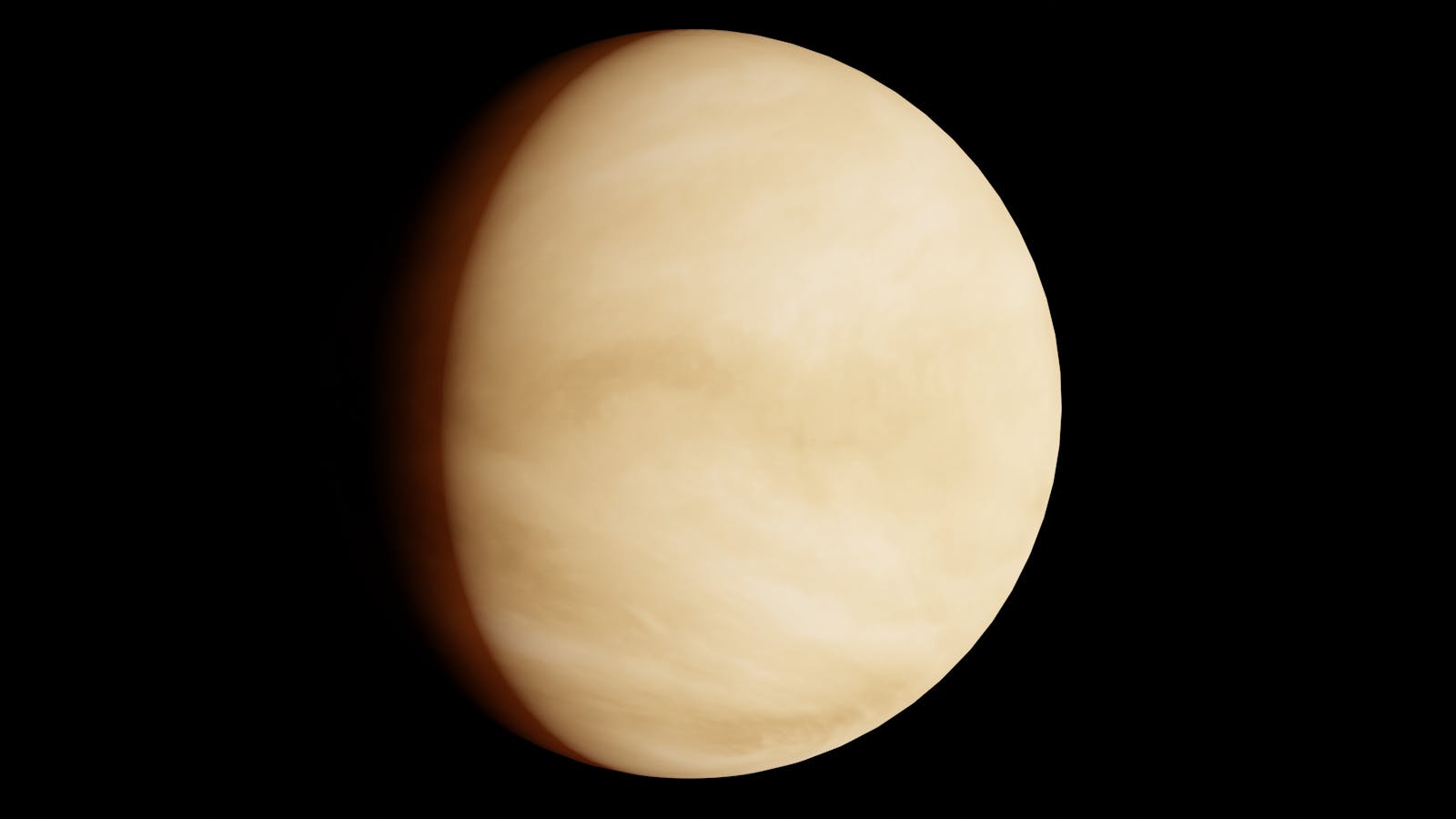
Scientists have identified the mechanism behind one of Venus’s strangest weather features: a 3,700-mile-long bank of sulfuric acid clouds that whips around the planet every few days. The cause, according to a team led by Takeshi Imamura, is a fluid-dynamics phenomenon called a hydraulic jump — the same physics that makes water spread into a flat disk when it hits a kitchen sink. On Venus, the effect plays out at a scale unmatched anywhere else in the solar system.
The finding settles a decade-long puzzle that began when JAXA’s Akatsuki orbiter spotted the cloud structure. It also exposes a gap in the global circulation models scientists currently use to simulate Venus’s atmosphere.
A wall of acid clouds, hiding in plain sight
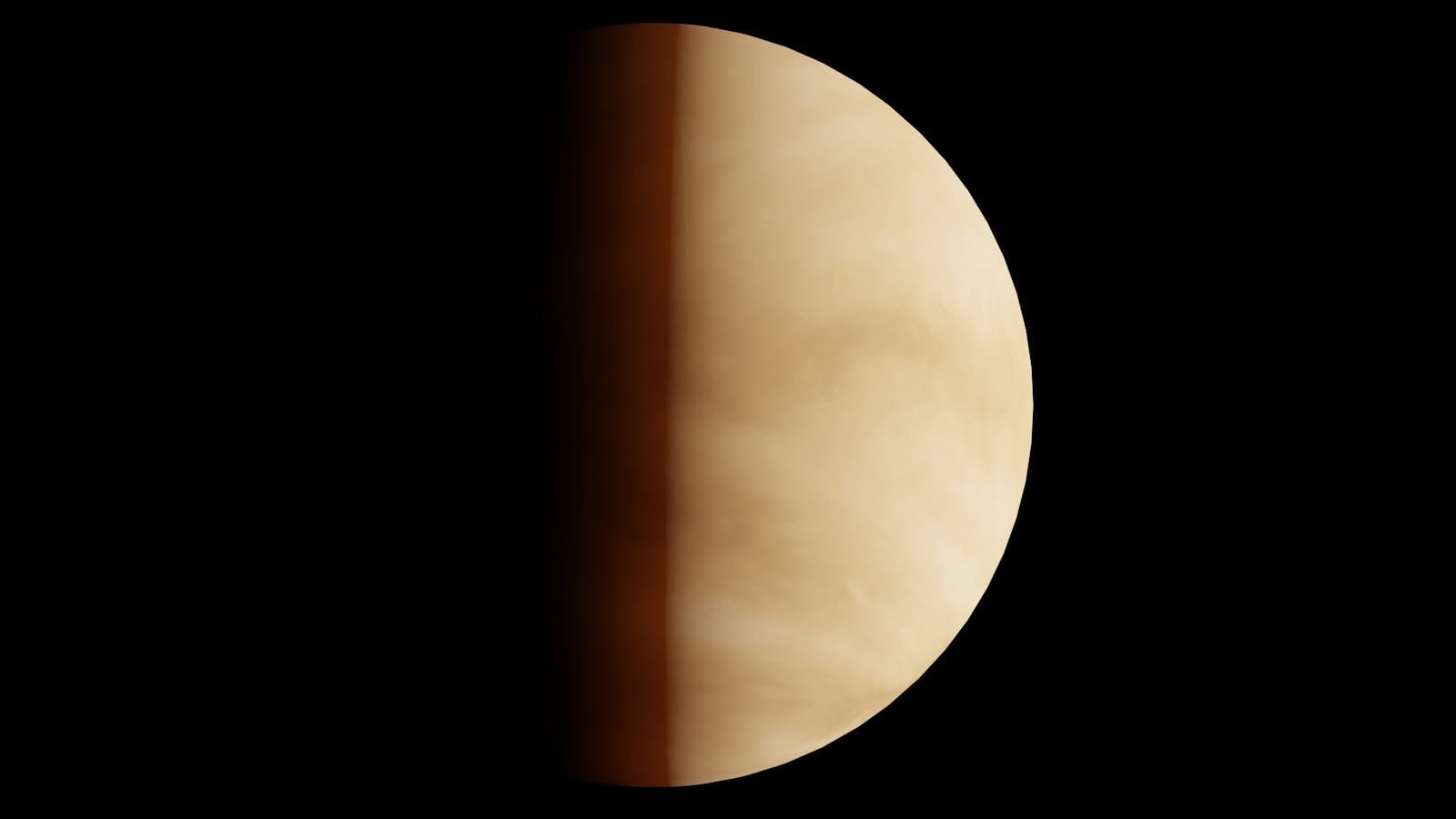
The cloud bank sits roughly 31 miles (50 kilometers) above the Venusian surface, deep inside the planet’s sulfuric acid haze. It stretches some 6,000 kilometers across the equator and races around the planet every few days, faster than the planet itself rotates.
Venus turns slowly. Its solid body completes a single rotation in 243 Earth days. Yet the upper atmosphere screams around the planet in just four days, a runaway phenomenon known as super-rotation that has puzzled planetary scientists for decades.
The disruption is not new. Reanalysis of older infrared data showed it had been lashing the equatorial clouds since at least 1983, but had gone unnoticed because earlier missions could not resolve the deep cloud layers in enough detail. JAXA’s analysis of Akatsuki infrared imagery showed the feature moving at roughly 328 kilometers per hour and sometimes extending 7,500 kilometers from north of the equator into the southern mid-latitudes.
What a hydraulic jump actually is
Turn on a kitchen faucet and watch the water hit the bottom of the sink. A thin, fast-moving sheet spreads outward, then abruptly thickens into a slower, deeper ring. That sudden transition is a hydraulic jump. Fast shallow flow runs into a region where it cannot stay shallow, and the fluid piles up.
The same physics operates in rivers, dam spillways, and Earth’s atmosphere over mountain ranges. What Imamura’s team has now shown is that it also operates on a planetary scale on Venus, where the working fluid is not water but a thick carbon-dioxide atmosphere laced with sulfuric acid vapor.
The trigger is a Kelvin wave — a large-scale equatorial atmospheric wave that propagates with the super-rotating winds. When the wave slows, the atmosphere behind it bunches up. Sulfuric acid vapor is forced upward, condensing as it rises into the dense cloud bank visible to Akatsuki’s infrared cameras.
The cloud disruption appears to be the largest known hydraulic jump in the solar system.
Why the discovery matters for climate modeling
Planetary scientists model Venus’s atmosphere using tools adapted from terrestrial climate science. Those tools, known as global circulation models, track winds, temperatures, and chemistry across a planet-sized grid. They have always struggled to reproduce Venus’s super-rotation cleanly, and the new finding suggests at least one reason why.
The existing Venus circulation framework, borrowed in structure from Earth models, does not include the hydraulic jump that has now been identified. That omission means simulations have been missing a mechanism that couples horizontal planetary-scale flow to localized vertical motion — exactly the kind of cross-scale coupling that fluid dynamicists usually treat as separate problems.
On Earth, climate models have spent decades wrestling with similar coupling problems. Venus, with its single dominant circulation regime and crushing 92-bar surface pressure, was supposed to be simpler. It is not.
The Akatsuki legacy
The discovery is one of the last major scientific results from Akatsuki, which launched in May 2010 and reached Venus orbit on its second attempt in 2015 after an initial engine failure.
Earlier Akatsuki work had already pointed to the deep equatorial atmosphere as a place where unusual dynamics were hiding. The probe identified an equatorial jet in the lower-to-middle cloud layer that may itself feed into the super-rotation puzzle. The hydraulic jump finding fits into that wider picture of a deep atmosphere doing more dynamical work than anyone expected.
For readers tracking the broader Venus revival, the timing is significant. Several missions — NASA’s DAVINCI and VERITAS, ESA’s EnVision — are in various stages of development. They will arrive at a planet that researchers now know is dynamically livelier than they thought.
How Venus’s atmosphere actually moves
The contrast with other planets sharpens what makes the Venus result unusual. On Jupiter, scientists using the James Webb Space Telescope recently identified a 515-kilometer-per-hour equatorial jet sitting in the gas giant’s lower stratosphere. That jet, like Venus’s super-rotation, sits at the equator and runs faster than the rotation below it. But Jupiter is a gas giant with enormous atmospheric depth and strong internal heat. Venus is a rocky planet roughly Earth’s size, with a thin solid crust and no obvious internal engine to drive such ferocious winds.
Something has to move momentum from the slow surface to the fast cloud tops. Kelvin waves, and now the hydraulic jumps they produce, are leading candidates for that something. The waves can carry energy upward through the atmosphere and deposit it at altitudes where the fastest winds blow.
That makes the hydraulic jump more than a curiosity. It is potentially a structural piece of how Venus maintains its super-rotation at all.
What comes next
The next step is rebuilding the global circulation models so they actually contain the physics that has been identified. That is harder than it sounds, because hydraulic jumps are notoriously difficult to resolve in low-resolution models — they happen at sharper spatial scales than planetary simulations typically capture.
For the broader field, the result is a reminder of how much basic atmospheric physics on other planets remains unmapped. Venus has been visited by more than three dozen spacecraft since the 1960s. A 35-year-old cloud disruption sat in the data the entire time, waiting for somebody to recognize what it was.
The deeper question raised by the work is one planetary scientists have been circling for years. Venus and Earth started out as near-twins. They diverged catastrophically. Understanding the dynamics that hold Venus’s atmosphere in its current state — including peculiar features like a planet-scale hydraulic jump — is part of understanding why two similar worlds ended up so different. The kitchen-sink physics turns out to matter at the planetary scale, and the planetary scale turns out to matter for how habitability is won or lost.
