
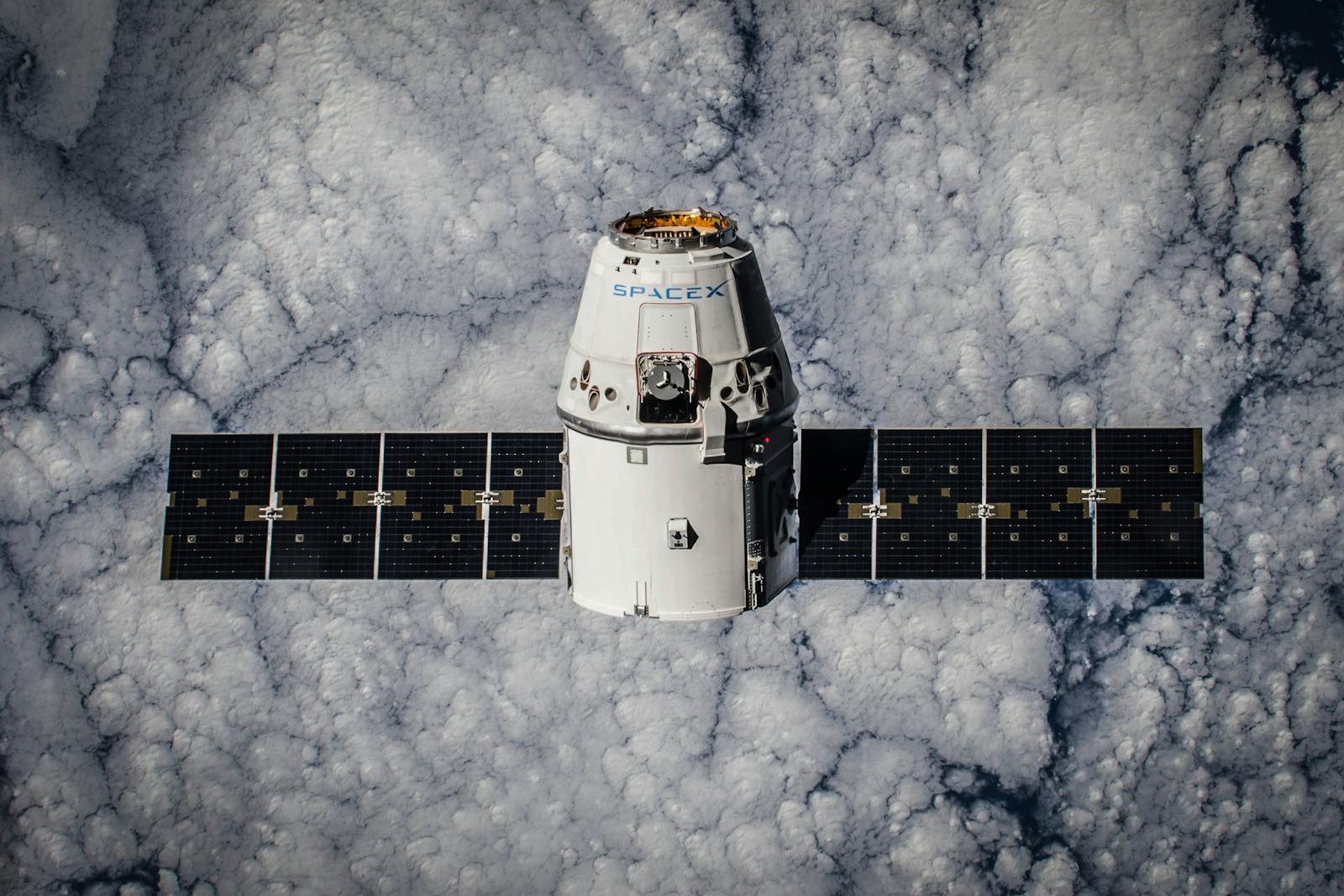
A shoebox-sized satellite carrying gallium and tungsten crystals is now circling Earth, attempting something particle physicists have never tested in orbit before: whether a neutrino detector can work from space. SNAPPY, described as the world’s first space-based neutrino detector, launched aboard SpaceX’s CAS500-2 rideshare mission on May 3, beginning a two-year orbital test of technology that could one day let scientists study the sun from much closer range.
The 3U CubeSat is roughly 12 inches long and 4 inches wide. Inside its small frame sits a prototype detector designed by Wichita State University physicist Nickolas Solomey and his team. Their argument is not that underground neutrino observatories are obsolete. It is that the standard Earth-bound strategy, building enormous detectors and burying them deep below the surface to reduce background noise, may not be the only way to approach solar neutrino science.
A different kind of telescope
Neutrinos are the ghosts of particle physics. They have almost no mass, carry no electric charge, and barely interact with matter. Tens of trillions of solar neutrinos pass through the human body every second, most leaving no trace at all.
That ghostliness is exactly what makes them valuable. Light from the sun’s core has to scatter through dense plasma before it reaches the surface, a process often described on timescales of many thousands of years. Neutrinos, by contrast, escape the solar interior almost immediately after being produced. They offer a way to study the fusion reactions powering the star without waiting for photons to work their way outward.
The problem is detection. Because neutrinos interact so rarely, experiments on Earth usually need either enormous detector mass, deep shielding, or both. China’s Jiangmen Underground Neutrino Observatory sits hundreds of meters underground. IceCube uses a cubic kilometer of Antarctic ice beneath the South Pole. Those projects are vast because neutrinos are so reluctant to announce themselves.
SNAPPY tests a different premise: instead of making the detector bigger, move the detector closer to a denser stream of solar neutrinos.
The thousand-fold advantage
According to NASA’s mission summary, the idea behind SNAPPY was partly inspired by Parker Solar Probe. As that spacecraft prepared to fly through the sun’s corona, Solomey focused on a simple physical advantage: near the sun, the solar neutrino flux can be nearly 1,000 times stronger than what reaches Earth.
That density gradient is the logic behind the mission. In principle, a much smaller detector positioned closer to the sun could see more neutrino interactions than the same detector near Earth. Space.com quoted Solomey saying that a one-kilogram detector closer to the sun could behave like a 1,000-kilogram detector on Earth.
SNAPPY is not there yet. Its current low Earth orbit will not deliver that solar-proximity boost. This first mission is a technology demonstration: survive the radiation environment, thermal cycling, and background noise of space; operate the gallium-and-tungsten crystal detector; and determine whether clean signals can be separated from everything else hitting the spacecraft.
If the approach works, Solomey’s team hopes it could support a later mission carrying a neutrino detector much closer to the sun.
Why the sun’s interior is still hard to see
Astronomers have built detailed models of the sun’s interior, but those models are mostly inferred. Sunlight tells scientists about the photosphere. Helioseismology reveals waves moving through the solar interior. Neither directly images the fusion reactions in the core.
Solar neutrinos offer a different route because they are born in those fusion reactions. Different processes inside the sun produce different kinds of neutrinos, and a sufficiently capable detector could help researchers study where those processes are happening.
That is the long-range promise, not the immediate payload goal. SNAPPY is too small and too close to Earth to turn the sun’s core into a picture. Its real job is to test whether the detector concept can function in orbit at all. The more ambitious version comes later, if the hardware proves itself.
A small satellite carrying a big argument
The CubeSat form factor matters here, and not only for cost. Neutrino science has often advanced through massive instruments, from deep underground tanks to Antarctic ice arrays. SNAPPY asks whether location could sometimes substitute for size.
NASA describes the payload as a prototype solar neutrino detector in low Earth polar orbit, with four crystals housed inside a CubeSat platform. Space.com reports that the detector is made from gallium and tungsten crystals, with a mission designed to validate technology for a future sunward detector.
That validation will not be easy. Space introduces the very problem underground laboratories are designed to avoid: noise. Cosmic rays, trapped radiation, charged particles, thermal swings, and spacecraft electronics can all complicate the signal environment. A space-based neutrino detector must show not only that it can register useful events, but that those events can be distinguished from the radiation soup around it.
One of several particle missions moving beyond the ground
SNAPPY is arriving during a busy period for space-based particle and plasma physics. NASA’s STORIE mission is designed to image energetic neutral atoms from Earth’s ring current after installation on the International Space Station. Its goal is not neutrino detection, but it reflects the same broader trend: using orbital platforms to study particles and fields that are difficult to understand from the ground alone.
What makes SNAPPY distinct is the target. It is not studying trapped particles around Earth, solar wind structure, or radiation belts. It is testing whether one of the universe’s least cooperative particles can be studied from a spacecraft.
What success would actually look like
Over the next two years, the mission’s success criteria are modest by the standards of frontier physics. Survive the orbital environment. Keep the detector stable. Generate usable signals. Characterize the background noise. Learn whether the gallium-and-tungsten approach can operate in space well enough to justify a larger, more ambitious follow-on mission.
If those boxes get checked, the conversation changes. A near-sun neutrino mission would be far more difficult and expensive, requiring serious thermal protection, radiation hardening, power, communications, and navigation. But it would no longer be only a thought experiment. It would have a working orbital technology demonstration behind it.
Solar physicists have been trying to understand the sun’s interior for generations. SNAPPY will not solve that problem by itself. But a detector smaller than a loaf of bread is now in orbit, testing whether the next way to look inside a star begins not under a mountain, but above the atmosphere.
