
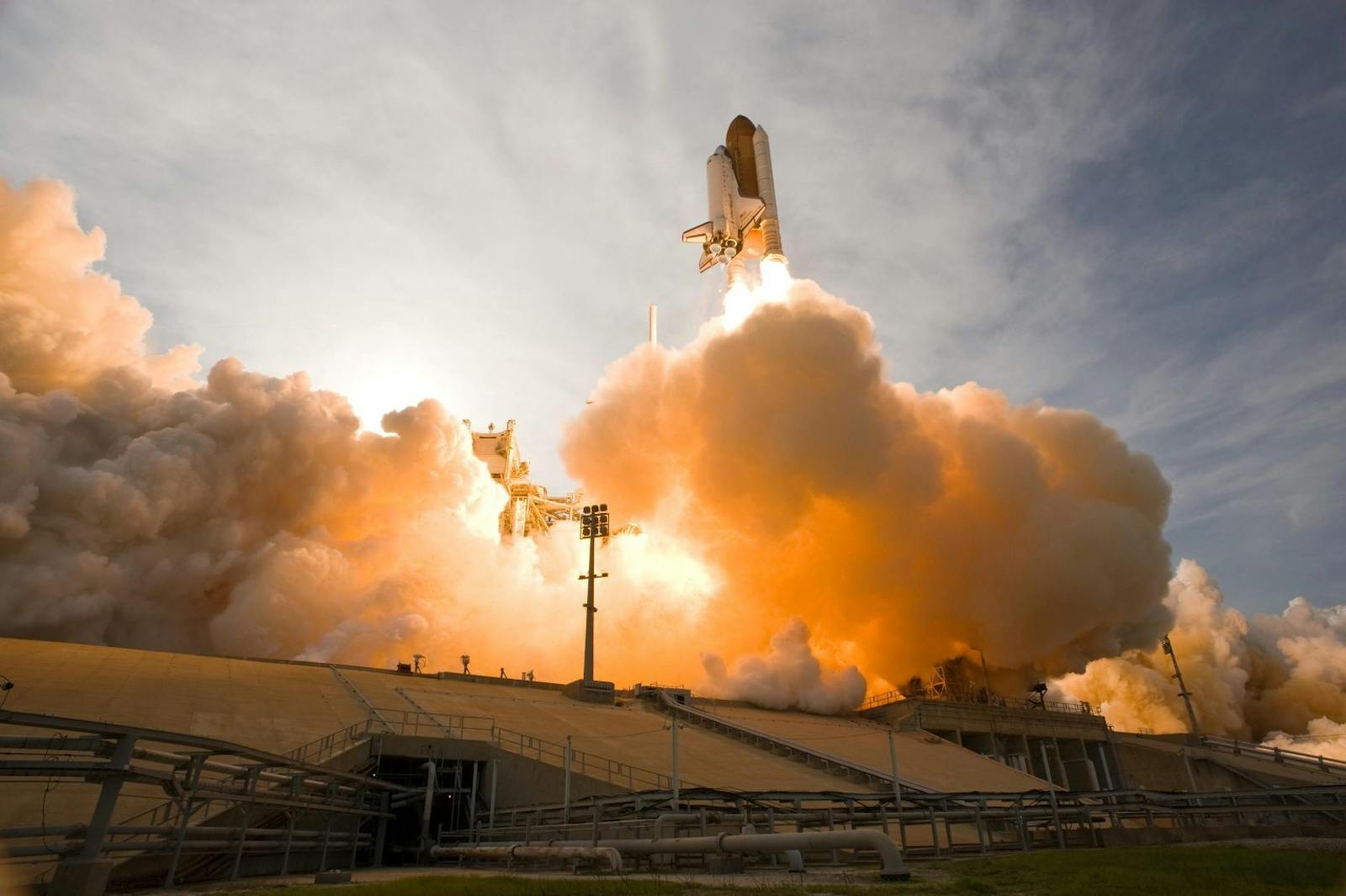
SpaceX will not attempt to catch the Super Heavy booster on Starship V3’s debut flight. The booster will steer itself to a soft splashdown in the Gulf of Mexico instead of returning to the launch tower’s mechanical arms — the maneuver that became the defining image of the program on multiple V2 flights. For a company that has made spectacle a core part of its engineering culture, skipping the catch is a tell. It signals what Elon Musk and his engineers actually care about getting right on this flight, and it isn’t the part that makes for a good replay.
What they care about is everything that happens after the booster falls away: a successful ascent on 33 new Raptor 3 engines, a clean hot-stage separation, and — most importantly — an in-space engine relight on the Ship upper stage. That relight is the gateway capability to orbital propellant transfer. And orbital propellant transfer is the capability that decides whether Artemis III happens this decade, whether SpaceX’s lunar contract with NASA is worth what the company has staked on it, and whether the long-term valuation underwriting the firm’s reported march toward a public offering survives contact with reality.
Why the catch is the part that can wait
SpaceX has already caught Super Heavy. It is a solved problem in the engineering sense, even if it remains a beautiful one in the public-relations sense. V3 is a substantially redesigned vehicle, and SpaceX has indicated the booster will not attempt a return to launch site on this flight because it is the first test of that new hardware. Risk a tower, risk a pad, risk the months of downtime that another Booster 7-style anomaly at Starbase would cost — for a maneuver the company has already demonstrated? The math does not work. Especially not when the same flight has to validate capabilities the program has never shown.
That is the quiet hierarchy of priorities the manifest reveals. Recovery theater is deferred. Refueling readiness is not.
What is actually new on V3
Almost everything beneath the stainless steel skin. The Super Heavy first stage now carries three grid fins instead of four, and each fin is larger and stronger than its V2 predecessor. SpaceX has also re-clocked the fins around the booster and lowered them to reduce heat exposure during hot-staging, the maneuver where the upper stage lights its engines while still attached to the booster.
The hot-stage adapter itself is now permanently integrated into Super Heavy rather than being jettisoned. The fuel transfer tube feeding the 33 Raptor engines has been redesigned to accommodate simultaneous startup, which SpaceX says will let all 33 engines start simultaneously, faster, and more reliably.
The engines themselves are new. Raptor 3 is lighter, produces more thrust, and integrates plumbing and sensors directly into the engine body, eliminating the separate heat shields that crowded the base of earlier vehicles. Ars Technica reported in February that the booster assigned to this flight, Booster 19, completed a four-day cryogenic proof campaign at the Massey’s Test Site after a previous V3 booster ruptured during a pressure test.
Refueling is the milestone that matters
Artemis III’s mission architecture does not work without orbital propellant transfer. The Human Landing System variant of Starship that NASA has contracted to put astronauts on the lunar surface cannot reach the Moon on a single tank. It has to be filled in low Earth orbit by a series of tanker Starships launching in close succession, docking, and transferring cryogenic methane and oxygen — a capability no one has ever demonstrated at this scale, with these propellants, in this configuration. Every other piece of the Artemis III plan, from the SLS launch of Orion to the lunar rendezvous, is downstream of whether SpaceX can make that refueling chain work.
That is why the in-space Raptor relight on this flight matters more than a tower catch. A relight proves the engines can be restarted in microgravity with settled propellant — the precondition for any orbital maneuver, any tanker rendezvous, any depot operation. Without it, the entire refueling architecture is hypothetical. With it, SpaceX can start flying the operational missions that actually test propellant transfer, which the company will need to do many times before NASA can credibly schedule a crewed lunar landing.
The same capability underwrites SpaceX’s commercial case. The next-generation V2 Starlink satellites that Falcon 9 cannot launch at scale, the orbital data center concepts the company has begun to discuss, the heavy science payloads, the eventual Mars cargo missions — all of them assume a Starship that can be refueled and reused on a cadence Falcon 9 cannot match. Scientific American noted that the flight arrives at a sensitive moment for SpaceX as a company, with the firm reportedly preparing for a public offering and needing to demonstrate that the vehicle underpinning its long-term valuation actually works. A booster catch would have been a nice video. A successful relight is the asset.
A new pad built for cadence
Flight 12 will also be the first launch from Starbase’s Pad 2, which the company says can fuel Starship faster than the original pad and uses shorter catch arms — the so-called chopsticks — adapted to V3’s geometry. A second operational pad at Starbase is itself a refueling prerequisite. Orbital propellant transfer for a single lunar mission may require multiple tanker launches in close succession. One pad cannot do that.
The pad debut adds risk. New ground systems are historically where rocket programs lose schedule, not in flight hardware. The failure of a previous V3 booster during pressure testing was a reminder that the unglamorous work of tanks, valves, and plumbing kills as many rockets as any aerodynamic surprise — and that the engineering attention not being spent on a catch attempt is attention that can be spent on the systems that determine whether tanker cadence is achievable at all.
What to watch on May 19
Three things will tell observers whether V3 is on track, and all three trace back to refueling readiness rather than recovery. First, whether all 33 Raptor 3 engines light cleanly and stay lit through ascent — the simultaneous startup is a new claim the company has not yet demonstrated, and engine reliability is the floor under any high-cadence tanker campaign. Second, whether the redesigned hot-staging works without damaging the booster’s lowered grid fins, because every booster lost is a tanker not flown. Third, whether Ship can perform the in-space engine relight, the single capability that separates a suborbital test article from an operational orbital vehicle — and the gateway to every propellant transfer demonstration that follows.
The dummy Starlink deployment is a secondary objective in engineering terms, but a primary one commercially. Starlink remains the cash engine that funds the rest of the company’s ambitions, and V3’s payload bay was designed around the next-generation V2 Starlink satellites that current Falcon 9 launches cannot accommodate at scale.
The broader physics of what Starship is meant to enable — heavy science payloads, off-world propellant logistics, eventually crewed deep-space transport — depends on this vehicle working. Other propulsion and energy questions in spaceflight, including the deeper questions about dark energy and cosmological models, are studied with instruments that Starship-class lift capacity would change profoundly.
For now, the schedule points to the debut of V3 from Starbase Pad 2, a booster splashdown in the Gulf, and a Ship arc to Australia. No tower catch this time. The maneuver SpaceX is choosing to skip tells you which maneuver — quiet, undramatic, performed out of sight in orbit — Musk needs to land before Artemis does.
Photo by Pixabay on Pexels
