
Delivery drones started crossing New York City’s East River in early May, kicking off a one-year pilot program that will test whether the technology that has spent a decade proving itself over Rwandan villages and Scottish moors can survive the helicopter traffic, regulatory friction, and community scrutiny of Manhattan and Brooklyn.
The operator is Skyports. The clients are the Port Authority of New York and New Jersey and the NYC Economic Development Corporation. The aircraft is a Brazilian-built Speedbird Aero DLV-2, a 55-pound electric multirotor about five feet across. The cargo, for now, is paper. The ambition is medical logistics: light pharmaceuticals, eventually blood and tissue samples, moved across one of the densest urban airspaces in the world without a courier, a van, or a bridge crossing.
Whether any of it makes economic or operational sense is, by the participants’ own admission, an open question. That is the point of the pilot.
A rare urban test for a rural technology
Drone delivery has been operating commercially for years, but almost entirely far from cities. Zipline, the most established player in the field, runs medical drone deliveries to roughly 5,000 health facilities across four continents, with its oldest program moving vaccines and blood products around Rwanda. Skyports itself has been flying mail to remote Scottish islands since 2023 and ferrying cargo to offshore wind turbines in Germany.
Cities have mostly been off limits. Too many people on the ground. Too many aircraft overhead. Too many regulators with overlapping authority. The NYC pilot, as Wired reported, is one of the few serious attempts to flip that pattern and run drones through a major metropolitan corridor.
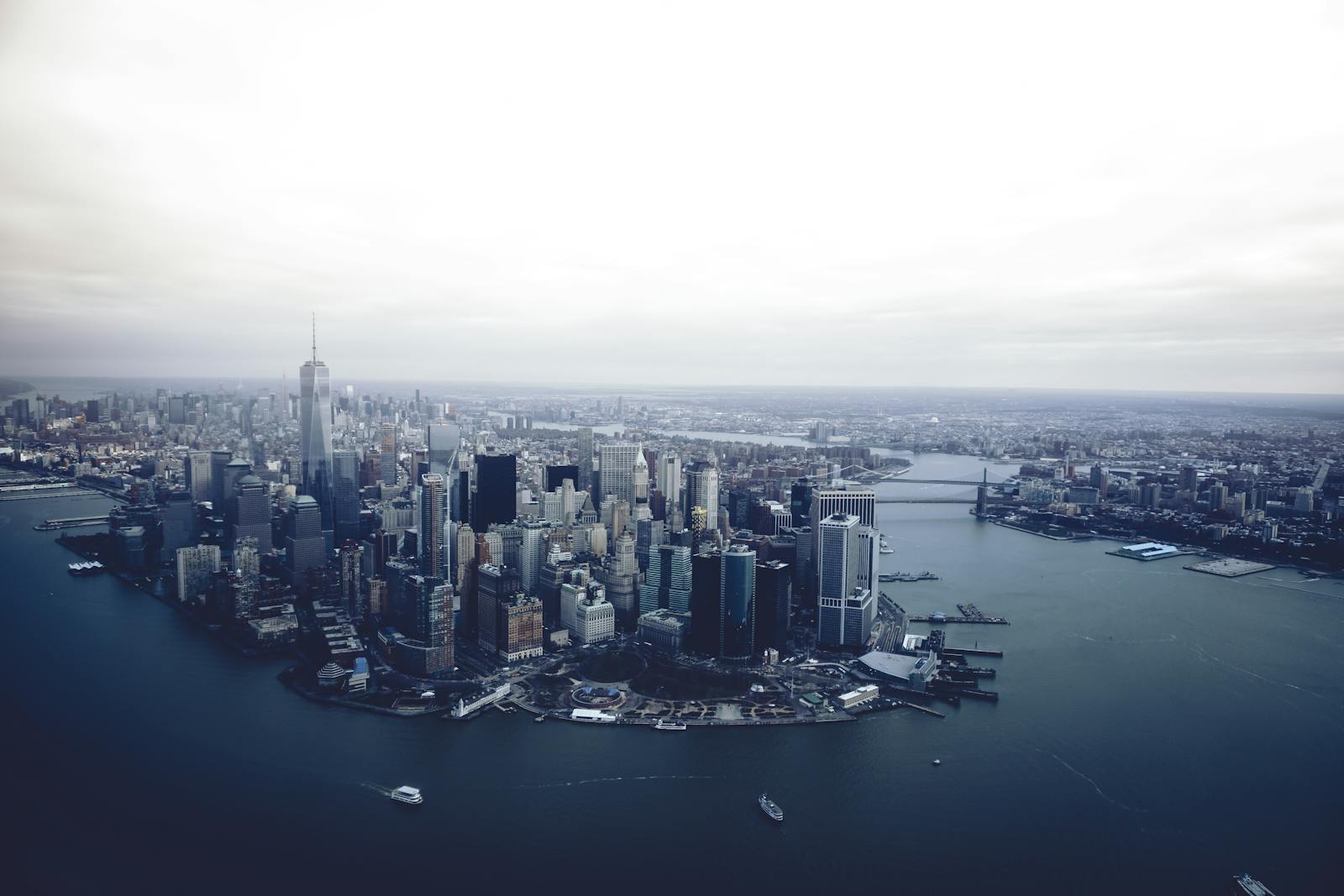
The route runs across the East River between the Downtown Skyport in lower Manhattan and the Brooklyn Marine Terminal. The drones share airspace with helicopters, seaplanes, and the approach paths of three international airports. Manhattan alone hosts three publicly owned heliports.
The math the Port Authority needs to see
Stephan Pezdek, Regional Freight Planning Manager at the Port Authority, framed the pilot’s success criteria in terms that sound less like a tech demo and more like a procurement review.
According to the Port Authority, the pilot’s success will be measured by flight frequency and whether the healthcare system finds value in the service. Officials are also evaluating whether drone deliveries can be faster and more cost-effective than current delivery methods.
That is the actual question. Not whether a drone can carry a package across a river, the technology can plainly do that, but whether it can do so often enough, fast enough, and cheaply enough to displace a courier on a motorcycle or a van crossing the Brooklyn Bridge.
The medical-logistics framing matters. It is the same framing Zipline used to win regulatory goodwill in Rwanda and Ghana, and it is the framing most likely to get sympathetic treatment from the FAA and local community boards. Faster delivery of critical medical supplies, if it actually materialises at scale, is the kind of public benefit that tends to soften procurement resistance.
The noise question nobody fully has an answer to
Skyports says the DLV-2 produces noise comparable to an electric toothbrush. That is the company’s framing, repeated consistently across its press materials and into trade coverage of the launch. Whether that holds up in practice, hovering on takeoff, climbing from a riverfront pier, passing within earshot of a waterfront apartment, is something the trial itself will surface.
Noise matters here because the city is already saturated with aircraft sound. Data compiled by the New York City Council recorded nearly 9,000 helicopter flights over the city’s land or water in May 2023 alone. Helicopter noise is one of the most consistent sources of 311 complaints in Manhattan. Adding a second category of low-altitude rotorcraft to that environment, even a much quieter one, is not a trivial political ask.
The city has anticipated this. The pilot requires weekly NYPD permits, fixed flight routes, FAA approval, certified pilots, and consultations with community boards. A dedicated 311 landing page has been set up to handle complaints and questions from residents.
Airspace is the real constraint
The technical bottleneck is not the drone. It is the airspace.
Beyond Visual Line of Sight operations, the regulatory category that allows a pilot to fly a drone they cannot directly see, remain the single biggest unresolved question in American commercial drone aviation. The FAA has been drafting a rulemaking framework for BVLOS operations for years, and the overhaul is expected to approach its finish line in 2026. Until then, every urban drone operation runs on bespoke waivers and route-specific approvals.
NYC’s air corridor is uniquely complicated. The Downtown Skyport, the same Manhattan facility now hosting the cargo drone flights, was also welcoming demonstrations of Joby Aviation’s electric air taxis in the days running up to the drone launch. The vertical layer of the city is filling up faster than the rules governing it.
Detection and avoidance technology, the systems that let an autonomous drone spot a helicopter and get out of its way, remains a serious engineering problem at low altitudes. Legacy collision-avoidance models, designed for higher-altitude commercial aviation, do not translate cleanly to the chaotic 400-foot-and-below environment where delivery drones live.
A pattern that keeps repeating
Drone delivery has been described as imminent for a decade. Australia’s program, one of the longest-running suburban trials in the world, has expanded slowly and remains commercially unproven. American projects from Amazon, Wing, and others have largely retreated to specific suburbs and college towns. The cargo-drone industry’s center of gravity has shifted toward larger payloads and longer ranges, with developments like unmanned aircraft built for tonne-scale freight and two-ton domestic logistics platforms moving regional cargo between airfields.
Small urban delivery has been the harder problem. Not because the engineering is more difficult, quite the opposite, but because the institutional surface area is enormous. Every flight involves the FAA, the Port Authority, the NYPD, a community board, an insurance underwriter, and a client willing to pay a premium for speed. The Rwanda model works partly because the alternative is a road that floods half the year. The NYC model has to compete with a courier on an e-bike.
What the pilot is really measuring
The one-year window is short by aviation standards and long by political ones. The measurable outputs are flight frequency, delivery times, cost per package, and complaint volume. The unmeasurable output is something closer to permission, whether New Yorkers, having seen drones cross the river for a year, decide they are tolerable, useful, or unacceptable.
That answer will shape the next decade of urban drone logistics in the United States more than any FAA rule. Regulators tend to follow the contours of what cities will accept. If Manhattan tolerates a delivery drone crossing the East River once an hour in exchange for faster blood deliveries, the precedent travels. If it does not, the entire urban drone-delivery thesis gets pushed back to whenever the next, quieter, more politically palatable generation of aircraft arrives.
For now, the drones are flying. The cargo is paper. The questions are bigger than the packages.
Photo by Casey Batong Ng on Pexels
