
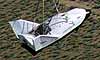

Washington, DC March 13, 1998 – Dropping down from a sun-washed sky over the Mojave Desert in California, the X-38 test vehicle landed on Edwards Dry Lake Thursday morning after its first flight test. NASA space officials declared the test a success, opening the way to some 20 additional flights in which a series of three scale models of what will eventually be a piloted rescue craft for the International Space Station will be verified.
In Thursday’s test, a model of the X-38 was carried aloft by a B-52
bomber, the same carrier airplane that once hauled the X-15 research
rocketship in the 1950’s and 1960’s. At 8:30am PST, the wingless craft,
based on a U.S. Air Force spacecraft design more than 25 years old, was
released for descent to the desert floor. Within four seconds after
separation, the X-38 deployed a special kind of steerable parachute called
a parafoil, or parasail.
The chute alllows ground controllers to direct the
craft to different landing sites. The sail was successfully deployed, but
during the glide back down to earth a tear developed in the chute that is
now under investigation. The damage did not effect the landing of the
craft, but space officials want to better understand what caused the tear
before sending the X-38 prototype up again.
Following a series of tests during the next two years, a larger full scale
version of the vehicle will be launched in the payload bay of a Space
Shuttle and placed adrift in orbit. The unmanned craft will then be brought
back to a controlled landing in a full test of its ultimate mission. NASA
and the space station’s international partners will keep X-38 vehicles
docked at the station for immediate emergency escape should troubles arise.
Astronauts will be able to board the craft and ride it back to earth
without need for controls – that function will be performed by “pilots” on
the ground. The X-38 will become operational on the station by 2003, if the
series of tests that started Thursday prove the design.
Reuseable Launch Vehicle Archive at Spacer.Com
Rotary
Kistler
X-3X
Other Space Planes
General RLV Industry Issues
