

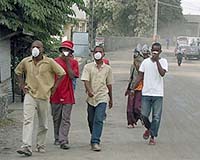
Nearly 120,000 people on the main island of the Comoros archipelago in the Indian Ocean have been left without safe drinking water after last week’s eruption of the Mount Karthala volcano, officials said Monday.
The Mount Karthala National Observatory recommended that residents of Grand Comore observe caution as the 2,361-meter (7,746-foot) mountain continued to rumble.
Ash from the eruption blanketed the island on Thursday and Friday, killing at least one infant, infiltrating homes, shops and offices and contaminating water in cisterns during the height of the dry season.
“We have two problems with water: one, we are in the dry season, and two, the reserves in many private cisterns are now polluted,” minister of state for defense Abdu Madi Mari told AFP.
He said cistern water supplies for some 120,000 residents mainly from rural villages near the volcano had been contaminated by the ash, which has also raised fears of respiratory ailments.
An assessment by local authorities found that about “as many as 118,000 persons living in 75 villages may be affected by the contamination of water tanks,” the UN Office for the Coordination of Humanitarian Affairs (OCHA) said.
Authorities on Grand Comore, the largest of the three semi-autonomous islands in the Comoros, have appealed for international assistance to help in distributing potable water to those in need, Mari said.
Thursday’s volcanic eruption — the second this year — produced no lava flows but sent some 2,000 villagers fleeing from their homes in the shadow of the mountain, OCHA said in a statement.
Almost all have now returned but the Mount Karthala Observatory said residents of the area should not let down their guard.
“Seismic tremors are continuing,” it said in a statement, adding that a lake of lava had formed inside the crater at the volcano’s summit.
The eruption was of the “phreatic-magmatic” type caused by the pressure when boiling hot magma comes into contact with water and produces steam, the observatory said, adding that further releases of ash and dust were possible.
In April, nearly 10,000 villagers living at the base of the mountain fled their homes after ash sparked widespread fears of drinking water contamination among Grand Comore’s 350,000 residents.
Mount Karthala last had a magma eruption in 1977, when lava destroyed the village of Singani, some 20 kilometres (12 miles) south of Moroni, and toxic gas was released into the air but did not cause any deaths.
