

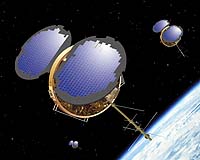
Universal Space Network Inc. said Wednesday it is providing real-time telemetry, tracking, control) and science-data delivery services to the COSMIC satellite network launched from Vandenberg Air Force Base April 14.
(USN), a leading provider of space operations, ground control and communications solutions, announced that
The $100 million COSMIC – which stands for Constellation Observing System for Meteorology, Ionosphere and Climate – array is based on a systems design provided by the University Corporation for Atmospheric Research in Boulder, Colorado. The program is a joint project between UCAR and Taiwan’s National Space Organization.
COSMIC – which is known as FORMOSAT-3 in Taiwan – was developed to lead the way in advancing real-time weather prediction, global climate change monitoring, and space weather forecasting technologies. USN will simultaneously deliver payload-science data to UCAR and telemetry, tracking and control information to NSPO for the duration of the mission, the company said in a statement.
COSMIC’s low-orbiting satellites will be the first to provide atmospheric data daily in real time over thousands of points on Earth for both research and operational weather forecasting by measuring the bending of radio signals from the Global Positioning System satellites as the signals pass through Earth’s atmosphere.
USN said it will rely equally on its tracking station in North Pole, Alaska, and a partner station in Kiruna, Sweden, which is owned and operated by the Swedish Space Corporation. The payload science and telemetry, tracking and control data from COSMIC will be automatically gathered and delivered from these two sites during each pass of the orbiting array.
The number of passes will increase from 14 to 84 per day over the coming months as the satellites adjust to their final orbit.
USN said the addition of 84 passes per day will represent the largest single increment of growth in its history. In preparation, the company has completed station and system upgrades including a new antenna at the North Pole site and in-house development of software automation tools to speed autonomous data delivery.
