

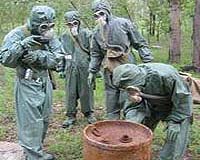
A 5-year project headed by U.S. government scientists is expected to lead to a better understanding how to clean contaminated sites.
The U.S. Department of Energy-funded $15 million task will build upon accomplishments occurring since April 2000 at the Environmental Remediation Science Program Field Research Center — a 243-acre contaminated area near the Oak Ridge National Laboratory. That area, and many other sites in the United States, is contaminated with wastes that include radionuclides, organics and nitrates.
“Our goal is to more accurately determine the long-term fate of contaminants from waste sites around the country,” said David Watson, manager of the department’s Field Research Center. “Through this effort we will bring to bear experts from multiple universities and national laboratories to help solve a problem of great national significance.”
Researchers from the Oak Ridge National Laboratory and elsewhere will develop numerical models that will allow them to predict the rate at which contaminant concentrations decrease through a combination of active remediation techniques and natural mechanisms such as dilution.
Scientists say subsurface contamination exists at more than 7,000 U.S. sites involving an estimated 1.7 trillion gallons of contaminated water and about 1.4 billion cubic feet of contaminated soil.
