
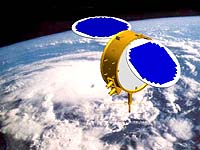
COSMIC is a joint U.S.-Taiwan scientific project, with a goal to launch a constellation of six microsatellites to collect atmospheric sounding measurements.
The scientific foundation for COSMIC is the radio occultation (limb sounding) technique which was developed by the Jet Propulsion Laboratory (JPL) and Stanford University in the late 1960s to study planetary atmospheres.
On April 3, 1995, a low-cost experimental satellite was launched that demonstrated the use of the Global Positioning System (GPS) in the radio occultation technique to estimate important weather and climate parameters, including atmospheric temperature, moisture, and pressure and electron density in the ionosphere.
The University Corporation for Atmospheric Research (UCAR) carried out this proof-of-concept experiment (GPS/MET), in cooperation with National Science Foundation (NSF), JPL, the University of Arizona, and other partners.
The GPS/MET satellite is still operating and more than 80 of peer-reviewed papers have been written validating the accuracy and potential utility of these GPS atmospheric limb-sounding techniques.
The COSMIC constellation is currently planned to be launched in early 2005, and is expected to last for five years. Data will be made available to the international scientific community in near real time.
The UCAR is soliciting an industry partners to build and deliver six (6) GPS receivers and six (6) solid-state recorders plus payload computers (SSR/PC) to fly on the spacecraft.
A formal Request for Proposal (RFP) is tentatively scheduled for release on or about 15 April 2001.
