

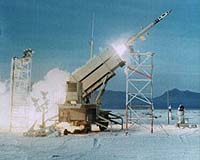
The United States has agreed in principle to Japan’s licensed production of US-developed surface-to-air missiles which will become the core of a joint missile defence system, a report said Tuesday.
Mitsubishi Heavy Industries Ltd., the top Japanese defence contractor, is expected to start building Patriot Advanced Capability 3 (PAC-3) missiles on license from US Lockheed Martin Corp. in the year to March 2006, the Nihon Keizai Shimbun said.
Officials at the Defence Agency or Mitsubishi were not immediately available to comment on the report.
The PAC-3 is a US army surface-to-air guided missile capable of intercepting missiles including North Korea’s Rodong, which has a range of about 1,300 kilometers (810 miles).
Japan plans to deploy in the year to March 2008 an anti-missile shield consisting of the land-based PAC-3 as well as the seaborne Standard Missile 3 (SM-3).
SM-3s intercept ballistic missiles when they reach their highest point outside of the atmosphere and PAC-3 missiles are used to destroy missiles that evade SM-3 attacks.
Japan and the United States have been engaged in joint technological research on a missile defence system since 1999, a year after North Korea fired a suspected ballistic missile over Japan and into the Pacific.
The Tokyo government has asked Washington to allow a Japanese firm to build the PAC-3 to help the Japanese defence industry maintain its manufacturing technology, the leading business daily said.
Relying totally on imports for PAC-3 missiles would have resulted in substantial losses for the Japanese defence industry, the report added.
The licensed production will enhance technological cooperation between the US and Japanese defence industries and help Japanese contractors maintain and boost their technological levels, the daily said.
The two countries are also negotiating on joint development of a next-generation system to replace the SM-3, it added.
Tokyo is expected to map out by the end of the year a new defense policy that advocates more investment in anti-missile and anti-terrorism resources and less spending on tanks, ships and other conventional weaponry, the daily said.
The two governments are expected to sign an official agreement on the licensed PAC-3 production early in 2005, the report said.
In the initial year of deployment, Japan may have to buy PAC-3 missles produced by Lockeed but Mitsubishi is expected to replace the major US defence contractor in supplying the missiles afterwards, the daily said.
