
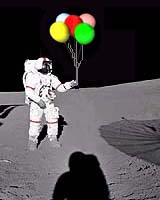
More than 30 years after American astronauts first walked on the moon, the United States is again setting its sights on the lunar landscape, but this time as a training base and springboard for manned flight far beyond — perhaps to Mars.
After the successful landing of a robotic rover on Mars last Sunday, President George W. Bush next week will announce new US space objectives, including manned lunar missions by around 2015, using the Moon as a pit stop, NASA sources said Friday.
The new initiative is the fruit of an inter-governmental group formed to redefine US space policy after the destruction of the space shuttle Columbia and the deaths of its seven astronauts on February 1, 2003.
Before that date, no manned lunar flights were on NASA’s books, said Don Savage of the space agency’s public relations.
“It is very important that we get NASA back to exploring, out of the Earth orbit,” said Rick Tumlinson, founder of the private Space Frontier Foundation in California. “We should have a commitment to create a community on the Moon.
“Developing a strong infrastructure with transportation between Earth and the Moon will make it easier to go to Mars. We don’t want a flag-and-footprint mission to Mars,” he said, alluding to the fact that, once the US flag and human footprints were planted on the Moon, the program was never pursued.
“We need something sustainable,” he said. “By working between the Earth and the Moon, we’ll learn to operate systems, so that it won’t be just a sprint to Mars without the ability to sustain it.”
The distance between the Earth and the Moon is 400,000 kilometers (250,000 miles).
But Tumlinson said the US government alone could not sustain a space program of that magnitude.
If the lunar base “is going to be a permanent facility, it has to evolve, and include it’s handing off to the private sector, companies, (and) universities,” said Tumlinson.
“They need to involve the private sector, work with other nations based on merit, based on their capabilities,” he said, adding: “we should call for European and Russian participation.
“What I’m afraid of,” he said, “is they’ll go to the Moon, lock everybody else out, and NASA will run the show.”
But, “It will never get cheaper if the government stays in control.”
Resumption of manned lunar flights was not an American brainchild. In 2002, Ouyang Ziyuan, chief scientist of Chinas moon exploration program, proposed sending Chinese astronauts to the moon and establishing a base there over the next decade.
China officially entered the elite club of manned space travel last year — joining the United States and the Soviet Union — with the launch of its Shenshu V (Divine Vessel) satellite, which orbited the Earth 14 times in 21 hours.
Zhang Qingwei, a top aerospace official, was quoted recently by the China Daily as saying, “We are looking to place 10 satellites into orbit in 2004…more than ever before.”
The Chinese program is said to be aimed at placing an unmanned satellite in orbit around the moon by 2007.
NASA spokesman Glenn Mahone said Bush was expected to unveil the ambitious new US plan on Wednesday at NASA headquarters in Washington.
The new space exploration blueprint was drawn up by Vice President Dick Cheney, NASA Administrator Sean O’Keefe and representatives from the Defense Department and other government agencies, NASA officials said.
They said the plan calls for retiring the ageing space shuttle fleet by 2010 and scaling back US involvement in the International Space Station (ISS) after it is completed by 2013.
NASA would develop an orbital space plane to ferry crews and cargo to the ISS — a prototype could be ready by 2008, which could be later adapted for longer voyages to the Moon and Mars, NASA officials said.
