
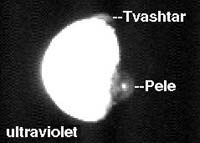
Two NASA spacecraft jointly observing Jupiter’s moon Io this winter captured images of a towering volcanic plume never seen before and a bright red ring of fresh surface deposits surrounding its source.
Combined information from images taken by the Cassini and Galileo spacecraft indicates the new plume is about the same size — nearly 400 kilometers or 250 miles high — as a long-lived plume from Io’s Pele volcano. Pele’s plume and ring are also seen in the new images.
The new plume originates from a volcanic feature named Tvashtar Catena near Io’s north pole. Scientists were astounded to discover so large a plume so near the pole, because all active plumes previously detected on Io have been over equatorial regions and no others have approached Pele’s in size, said University of Arizona planetary scientist Dr. Alfred McEwen.
Galileo might pass right through the Tvashtar plume in August, if the plume persists until then. The spacecraft will be flying over that part of Io at an altitude of 200 kilometers (124 miles).
Material in the plume is tenuous enough to present little risk to the spacecraft, and passing through it could give an opportunity to analyze the makeup of the plume, said Dr. Torrence Johnson, Galileo project scientist at JPL.
