
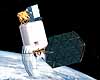
TRW Inc. has opened a new electric propulsion test facility designed to enhance the company’s role in the implementation of this technology for spacecraft applications. The Cryogenic Electric Propulsion Test Stand (CEPTS) at TRW’s Space Park facility contains state-of-the-art equipment that will be used to optimize electric thruster designs, perform in-house testing of integrated systems, and support customer-funded testing.
“Electric propulsion is an industry-recognized key discriminator
for some satellite systems,” said Mary Kriebel, TRW manager for the
Propulsion Systems Engineering section. “Recent improvements in space
power systems have made electric propulsion feasible, and the fuel
efficiency of electric propulsion makes these systems highly
desirable.
“The demand for electric propulsion systems is growing rapidly in
the coming decades, especially for telecommunications satellites,”
Kriebel added. “CEPTS is a key ingredient in keeping TRW on top of,
and competitive with, evolving electric propulsion technology.”
CEPTS was developed to provide the space-like vacuum conditions
necessary for testing various electric propulsion thrusters, such as
Hall Effect Thrusters and pulsed plasma thrusters. The facility
features a test cell approximately 7 feet in diameter and 17 feet
long, and has three 48-inch cryogenic vacuum pumps to allow the
chamber to maintain very high vacuum levels while a thruster is
operating.
The company-funded facility is also being outfitted with an
autonomous data acquisition and control system that will allow
unmanned operation and data collection during long-duration testing.
System life testing can demand in excess of 5,000 hours, requiring
automation in test control and data acquisition. Opened last month,
the facility operated successfully the first time it performed
thruster testing.
Electric thrusters have much higher specific impulse than
chemical thrusters, and provide two to three times more fuel
efficiency than chemical thrusters. Higher fuel efficiency means that
not as much propellant is needed on-board, allowing spacecraft
designers to reduce overall spacecraft weight and launch costs or to
add more weight and capability to the payload.
Electric propulsion is applicable for multiple types of in-space
missions, ranging from inserting spacecraft into specific orbits to
repositioning spacecraft, stationkeeping, constellation management,
and on occasion, deorbitting a spacecraft.
TRW has conducted electric propulsion research and development
for many years. Under Air Force funding, TRW headed an industrial team
that delivered a flight arcjet system for integration onto the Air
Force’s Advanced Research and Global Observation Satellite. TRW is now
conducting sponsored and internally-supported efforts to develop
selected electric propulsion technologies.
