
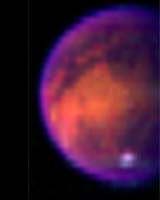
Encircled in purple stratospheric haze, Saturn’s largest moon, Titan, appears as a softly glowing sphere in this colorized image taken on July 3, 2004, one day after Cassini’s first flyby of that moon. Titan has a dense atmosphere composed primarily of nitrogen with a few percent methane. The atmosphere can undergo photochemical processes to form hazes.
Images like this one reveal some of the key steps in the formation and evolution of Titan’s haze. The process is thought to begin in the high atmosphere, at altitudes above 400 kilometers (250 miles), where ultraviolet light breaks down methane and nitrogen molecules.
The products are believed to react to form more complex organic molecules containing carbon, hydrogen and nitrogen that can combine to form the very small particles seen as haze.
This ultraviolet view of Titan has been falsely colored. The main body is colored pale orange as seen in true color images. Above the orange disc are two distinct layers of atmospheric haze that have been brightened and falsely colored violet to enhance their visibility.
It is not currently understood why there are two separate haze layers. This and other questions await answers as the four-year Cassini tour continues, with many more planned flybys of Titan. The upcoming October 2004 flyby of Titan will be 30 times closer than that of July 2.
