
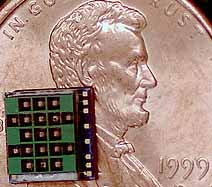
A micro-thruster array measuring one-quarter the size of a penny, designed by a TRW-led team for use on micro-, nano- and pico-satellites, has successfully demonstrated its functionality in a live fire test aboard a Scorpius sub-orbital sounding rocket.
Individual micro-electromechanical system (MEMS) thrusters, each a poppy seed-sized cell fueled with lead styphante propellant, fired more than 20 times at 1-second intervals during the test staged at the White Sands Missile Range. Each thruster delivered 10-4 Newton seconds of impulse.
“The test proves the technology behind this micro-thruster is well along in its development,” said David H. Lewis, Jr., TRW’s MEMS Digital Micro-Propulsion project manager.
“We’re very pleased with its performance at White Sands. We believe micro-thrusters have the potential to provide on-orbit propulsion for station keeping, orbital correction and attitude control for future, very small satellites weighing from less than a pound to as much as 50 pounds.”
The MEMS design, based on silicon chip fabrication technology, offers several advantages over conventional thrusters: It has no moving parts, utilizes a variety of propellants, is scalable, eliminates the need for tanks, fuel lines and valves, and fully integrates the structure of the satellite with the propulsion to power it.
The micro-thruster is being developed by TRW and teammates Caltech and the Aerospace Corp. under a contract from the Defense Advanced Research Projects Agency.
The MEMS micro-thruster arrays are fabricated as a three-layer silicon and glass sandwich, with the middle layer consisting of multiple small propellant cells sealed with a rupturable diaphragm on one side and an ignitor on the other.
Each cell is a separate thruster, and when ignited, delivers one impulse bit. Delivering propulsion in discrete increments by igniting thrusters in controlled sequences has lent the technology the name “digital propulsion.”
