
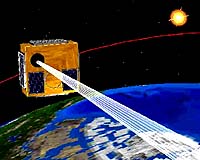
Canada’s newest and least expensive space science satellite, which is being developed by a team led by Dynacon Enterprises Limited of Mississauga, Ontario, took an important step closer to orbit today.
The signing of a Launch Service Agreement for Canada’s MOST (Microvariability & Oscillations of STars) microsatellite was announced today by the Canadian Space Agency (CSA) and Eurockot Launch Services of Bremen, Germany. MOST, carrying Canada’s first space telescope, is scheduled to launch in October 2002 from Plesetsk, Russia on a former SS-19 ICBM, the “Rockot” launch vehicle.
MOST is funded and managed by the CSA’s Space Science Branch under its Small Payloads Program. Dynacon, as Prime Contractor for the mission, leads the team that has developed the satellite and its ground stations, and that will operate MOST after launch for the CSA.
The Principal Investigator, Prof. Jaymie Matthews of the University of British Columbia (UBC), leads a team of scientists from across Canada, the United States and Austria, who will use measurements of the brightness of stars from the telescope on MOST to help set a limit on the age of the Universe¿one of the original objectives of MOST’s larger cousin, NASA’s Hubble space telescope¿and to probe the properties of planets around other stars.
With a size about the same as a small suitcase (60 by 60 by 20 centimeters) and weighing only 60 kilograms, MOST belongs to the class of very small, low cost satellites known as microsatellites.
However, with its very precise astronomical telescope, and a Dynacon-developed “attitude control system” for extremely accurate pointing control, MOST “punches above its weight” with capabilities normally found only on much larger satellites. It has a planned mission length of one year.
MOST is also the least expensive satellite ever developed in Canada¿for comparison, costs for other Canadian satellites range between 5 and 75 times the cost of MOST¿and is one of the lowest-cost space science satellites in the world.
The CSA is providing approximately $6.5 million (US$4 million) to the MOST team via Dynacon’s prime contract, to pay for the design and construction of the satellite and its ground stations, as well as to operate MOST after it is launched.
The Ontario government has helped to support the development of the MOST integration facility at the University of Toronto Institute for Aerospace Studies (UTIAS), through its Ontario Research and Development Challenge Fund.
The MOST project is a co-operative Canadian scientific partnership. Dynacon developed the design for the overall MOST system, and has managed the satellite development program. The telescope carried by MOST is being developed by a team at UBC, led by Prof. Matthews.
Dynacon and UTIAS are developing the satellite’s “bus”¿which supports the telescope, points it in the correct direction, and provides it with power, data processing and communications services¿and ground control stations.
The satellite is being assembled at UTIAS, with participation of all principal team members. Other key partners include the Centre for Research in Earth and Space Technology (CRESTech) of Toronto, Spectral Applied Research of Concord, Ontario, Routes, Inc. of Ottawa, the Radio Amateur Satellite Corporation (AMSAT) and the Royal Astronomical Society of Canada (RASC).
