
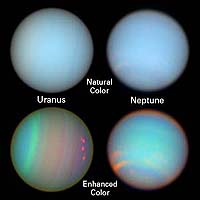
Atmospheric features on Uranus and Neptune are revealed in images taken with the Space Telescope Imaging Spectrograph and the Advanced Camera for Surveys aboard NASA’s Hubble Space Telescope. A wider view of Uranus reveals the planet’s faint rings and several of its satellites. The observations were taken in August 2003.
Uranus and Neptune:
The top row reveals Uranus and Neptune in natural colors, showing the planets as they would appear if we could see them through a telescope. The images are made of exposures taken with filters sensitive to red, green, and blue light. In the bottom images, astronomers used different color filters to detect features we can’t see. The photographs demonstrate that, by using certain types of color filters, astronomers can extract more information about a celestial object than our eyes normally can see.
At first glance, the top row of images makes the planets appear like twins. But the bottom row reveals that Uranus and Neptune are two different worlds. Uranus’s rotational axis, for example, is tilted almost 90 degrees to Neptune’s axis. The south poles of Uranus and Neptune are at the left and bottom, respectively. Both are tilted slightly toward Earth. Uranus also displays more contrast between both hemispheres. This may be caused by its extreme seasons.
Both planets display a banding structure of clouds and hazes aligned parallel to the equator. Additionally, a few discrete cloud features appear bright orange or red. The color is due to methane absorption in the red part of the spectrum. Methane is third in abundance in the atmospheres of Uranus and Neptune after hydrogen and helium, which are both transparent. Colors in the bands correspond to variations in the altitude and thickness of hazes and clouds. The colors allow scientists to measure the altitudes of clouds from far away.
Uranus (A Wider View):
This wider view of Uranus reveals the planet’s faint rings and several of its satellites. The area outside Uranus was enhanced in brightness to reveal the faint rings and satellites. The outermost ring is brighter on the lower side, where it is wider. It is made of dust and small pebbles, which create a thin, dark, and almost vertical line across the right side of Uranus (especially visible on the natural-color image).
The bright satellite on the lower right corner is Ariel, which has a snowy white surface. Five small satellites with dark surfaces can be seen just outside the rings. Clockwise from the top, they are: Desdemona, Belinda, Portia, Cressida, and Puck. Even fainter satellites were imaged in deeper exposures, also taken with the Advanced Camera in August 2003.
