
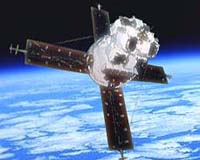
AeroAstro, Inc., a leading provider of small satellites and related technology products, has announced that the ALEXIS satellite has successfully completed its 10th year of on-orbit science operations.
ALEXIS, the advanced X-Ray astronomy satellite built by AeroAstro for Los Alamos National Laboratory (LANL), has far surpassed it nominal six-month mission and three-year engineering lifetime estimate. ALEXIS has achieved its mission of demonstrating its telescope and radio-receiver technology for nonproliferation applications, while obtaining cutting-edge science results.
ALEXIS, the first satellite designed and built by AeroAstro, was the first of a new generation of high-performance small satellites. It combined high power, high data rates and highly precise attitude control with low development and operations cost. The satellite’s scientific packages include the Blackbeard radio experiment and the Array of Low-Energy X-ray Imaging Sensors telescopes, both developed at LANL.
The 45 kg (100 lb) spacecraft bus, built for less than $3M by AeroAstro, provides redundant digital computer systems, 1 Gbit solid state memory, attitude control and determination, 65W of continuous power to the payloads and 750 kbit/sec digital communications system, which has carried vast quantities of science data to LANL and uplinked periodic software upgrades to implement new instrument operation modes.
Dr. Rick Fleeter, AeroAstro’s CEO, said, “ALEXIS was a pathfinding satellite ¿ enabling Los Alamos to quickly assess the potential of two promising technologies and achieve important scientific results while the technology was fresh and at a budget affordable without the need of external funding sources.
“ALEXIS began a process, still underway at AeroAstro, to put space into the hands of more users, and to make space relevant to more individual, business and societal needs via lower cost and more rapid development schedules for highly capable spacecraft that enable cutting-edge missions. AeroAstro is proud to have developed the satellite that has enabled LANL to provide the community with a decade of groundbreaking science.”
