
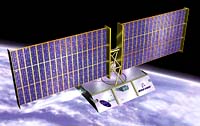
Teledesic LLC, a satellite communications services company, today announced that it has down-selected satellite manufacturers Alenia Spazio, a member company of the Finmeccanica group in Italy, and Lockheed Martin Commercial Space Systems of the United States as the two finalists to build Teledesic’s global, broadband Internet-in-the-Sky(R) satellite communications network.
Teledesic intends to select one prime contractor and finalize its contract this fall.
“Despite the current financial markets, we still intend to deliver on our promise of broadband connectivity on a global scale,” said Dennis James, Teledesic’s president.
“We are confident that we can work with either of these world-class satellite manufacturers to complete and deliver an initial system that will be significantly less expensive than earlier designs.”
Teledesic has been engaged in active discussions with potential domestic and international industrial partners to determine the best, most cost-effective path forward for its broadband satellite communications network.
The company has received its Federal Communications Commission license and the necessary international spectrum allocation from the International Telecommunication Union to begin offering service on a global basis.
Both Alenia Spazio and Lockheed Martin Commercial Space Systems (LMCSS) have experience building non-geostationary orbit (NGSO) satellite systems.
This experience, together with their existing manufacturing, integration and testing facilities and processes will reduce risk in developing and deploying a NGSO system under tight deadlines.
In addition, these prior programs enable the use of cost-effective satellite manufacturing techniques and capitalize on prior supplier relationships for manufacturing low-cost NGSO systems.
Alenia Spazio was responsible for integration and testing on the Globalstar program. It built a factory for this purpose in Rome that can be readily used for manufacturing Teledesic’s satellites.
Alenia Spazio has developed extensive testing procedures and processes that enable the company to build satellites in a short time period. Alenia Spazio also was the first satellite manufacturer to build commercial geostationary Ka-band satellites.
“We are confident that the present market situation will be overcome and that broadband satellite constellations will become a must in the future,” said Alenia Spazio CEO Giuseppe Viriglio.
“We are also confident that with our past experience and current involvement Alenia Spazio can do a good job for Teledesic. We are prepared to face the stiff competition and trust that we shall become a major partner of Teledesic,” added Viriglio.
Lockheed Martin Commercial Space Systems was the supplier of the Iridium satellite bus, or chassis. LMCSS has experience in building low-cost buses for NGSO systems as well as extensive experience developing Ka-band system payloads, the “brains” of the satellite. Teledesic’s satellite will operate in the high-frequency Ka-band of spectrum.
“We are pleased that Teledesic has selected Lockheed Martin to be a finalist to develop its global, broadband satellite communications system,” said Ted Gavrilis, president of Lockheed Martin Commercial Space Systems. “Our team has the talent and experience to provide a world-class solution and we look forward to working with Teledesic on this exciting program.”
Telecommunications pioneer Craig McCaw and Microsoft founder Bill Gates are Teledesic’s two primary founding investors. Strategic investors also include Motorola, Saudi Prince Alwaleed Bin Talal, The Boeing Company and The Abu Dhabi Investment Company.
Teledesic aims to be the first licensed satellite communications network that will enable affordable, worldwide access to advanced telecommunications services such as computer networking, broadband Internet access and interactive multimedia.
