
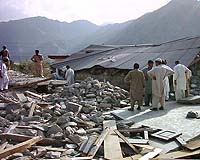
Survivors of the South Asia earthquake have been able to make contact with loved ones for the first time since disaster struck – using Inmarsat mini-M phones.
Inmarsat-sponsored aid agency Telecoms Sans Frontieres (TSF) offered priority calls to survivors in Balakot, Pakistan – one of the areas badly affected by the disaster – to speak to anxious relatives and friends.
Long-awaited news
Residents of Balakot made many calls to other Pakistani towns that had escaped the ravages of the earthquake, as well as overseas to countries such as Saudi Arabia.
They were able to give family and friends the long-awaited news that they had survived the quake and ask them for their help.
Growing concern
The 7.6 magnitude earthquake struck close to Muzaffarabad in Pakistan-administered Kashmir on October 8.
Latest official figures put the death toll at 25,000. More than 63,000 people have been injured – and there is growing concern for the 2.5 million people left homeless.
Badly injured
One of the survivors – Hassan – lives in Balakot. He lost his two sisters and three brothers on the day the earthquake struck. His wife survived but her legs were badly injured.
Carrying his wife, Hassan walked 3kms to the nearest hospital. Had he not done so, she would have lost her legs. Since the day he left her with the doctors at the hospital, Hassan had received no news.
Wife recovering
But thanks to the TSF mobile crew, Hassan was able to speak to the hospital. Doctors have confirmed that his wife is recovering and should be able to walk again soon.
Hassan’s next priority is to rebuild his house, which – along with thousands of other homes – was obliterated by the quake.
Telecoms centres
As well as a mobile crew in Balakot, TSF has established internet links at the heart of the United Nations’ rescue centre in Muzaffarabad in Kashmir – the worst-hit region in northern Pakistan.
A second TSF team has installed a telecommunications centre for rescue workers based in nearby Mansehra.
Inmarsat equipment
TSF is using a range of Inmarsat equipment to help rescue workers – including 10 Inmarsat mini-Ms and four Inmarsat R-BGAN terminals.
But the aid agency plans to send more crews with additional equipment to the area in the next few days to strengthen teams in the field.
