
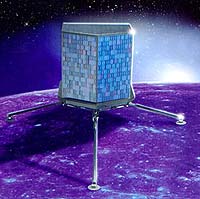
Surrey Satellite Technology has won a contract from DLR in Germany to manufacture and supply the attitude control momentum wheel for the Rosetta Lander mission to be launched in 2004.
The Rosetta spacecraft will rendezvous with comet 46 P/Wirtanen as it makes one of its periodic visits to the Sun. The spacecraft will map the comet’s surface in fine detail and land a package of instruments (the Rosetta Lander) on the comet surface.
SSTL’s wheel will have to survive a cruise time of 9 years through space and then be used for the last critical 20 hours during the final approach and landing on the comet.
The dry lubricated bearings used by SSTL are ideal for this type of mission due to their unlimited shelf life over a wide temperature range (-185 to +300 deg C) in a vacuum.
The wheel is similar in size to that onboard SSTL’s UoSAT-12 minisatellite, launched in April 1999 and operational in low Earth orbit.
A momentum wheel is a fast rotating disc. Normally the speed of rotation is a few thousand revolutions per minute — similar to a gyroscope. The wheel is mounted inside the satellite so that the spin direction is inertially fixed, giving the satellite an inherent gyroscopic rigidity in this direction. This means that external disturbances will find it difficult to change the satellite’s attitude away from this pointing direction, in the same way that it is difficult to push over a spinning top (gyroscope).
By changing the momentum wheel’s speed over a limited range (less than 10% of the nominal speed) the satellite can easily be rotated around the spin direction, thus rotational momentum can be exchanged between the wheel disc and the satellite’s body. Therefore, the momentum wheel will keep the 3-dimensional attitude of the satellite fixed in the spin direction, whilst rotating the satellite freely around the spin direction.
