
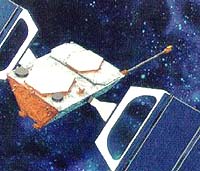
Surrey Satellite Technology Limited (SSTL) in England has acquired the manufacturing rights to the Weitzman Gravity Gradient Boom from Weitzman Inc. (USA).
The SSTL-Weitzman deployable 6-metre boom is a key element in providing passive, low cost, gravity gradient stabilisation for micro and mini class spacecraft. It has also been used extensively for deploying space science instruments away from spacecraft bodies.
The boom has a prestigious flight heritage having already been used on more than 50 satellite missions over the last 20 years — including SSTL’s last 14 commercial, military and research missions.
SSTL microsatellites in low Earth orbit using the Weitzman boom in combination with SSTL’s magnetorquer systems, have achieved nadir pointing accuracy better than 0.5 degrees — without any lifetime-limiting moving parts or consumable resources.
The boom comprises a deployable STACER spring extendable boom, support brackets, a deployment indicator and a centrifugal break mechanism providing low shock release.
An instrument or tip-mass up to 6kg can be mounted on the end of the standard deployable boom. In its stowed state, the two sections typically form a compact unit 130mm OD/300mm long, with a total mass of 5.5kg (with 3.3kg tip-mass).
Deployment is initiated using dual redundant pyrotechnic cutters and once fully deployed (after 5-10 seconds), the STACER unit forms a self supporting 6-metre-long rigid boom.
Various mechanical interfaces can be supplied with the unit: electrically it can be supplied with flying leads, or as a complete unit with CAN, PIC or serial microcontroller interfaces.
SSTL have installed a test bed at their manufacturing facilities at the Surrey Space Centre. Each boom is mounted onto a horizontal deployment track with a low friction trolley supporting the tipmass which is free to rotate about the deployment axis. The tests are videotaped and the microswitch click data recorded, followed by measurement of the deployed length.
