
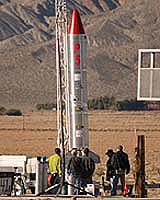
A joint industry – academic team achieved an important milestone on Saturday, 04 December 2004, when they conducted their initial launch and recovery of a full-scale flight development unit for a proposed Nanosat Launch Vehicle (NLV).
The NLV is intended to provide dedicated, primary launch services to small satellite developers and operators whose spacecraft have a mass of 10 kg or less.
Working together through the California Launch Vehicle Education Initiative (CALVEIN), Garvey Spacecraft Corporation (GSC) and California State University, Long Beach (CSULB) successfully launched and then recovered their Prospector 5 vehicle by parachute.
The team conducted these operations at the Mojave Test Area that is owned and operated by the Reaction Research Society (RRS). The Prospector 5 is an early, low-fidelity version of the NLV first stage.
The primary objective for this flight test was the demonstration that the CALVEIN team could develop and handle a vehicle of this scale.
In addition, a “fincam” payload provided by a member of the CSULB student team transmitted on-board video of the first several seconds of flight, typifying the kind of academic experiments that are envisioned for operational NLV missions.
Also noteworthy with respect to other small launch vehicle development programs that are focusing on “responsive space launch” was that all field operations for the Prospector 5 flight test – from vehicle delivery through set-up, launch, recovery and loading for the trip back to the CSULB campus – were conducted in less than one day.
The successful recovery of the vehicle means that the CALVEIN team will be able to reuse the hardware in future flight testing.
In addition to such full-scale vehicle test and evaluation, GSC, CSULB and other partners are also addressing alternative propellant combinations, the use of advanced materials for engine chambers and innovative approaches to payload accommodations.
Previous team achievements include the first ever powered flight tests of a liquid-propellant aerospike engine in 2003. Future versions of such aerospike engines may be used to improve the performance of later iterations of the NLV.
