
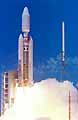
Air Force Space Command released Tuesday results of its investigation into the failure of the Inertial Upper Stage, or IUS, during a Titan IVB launch on April 9, 1999, from Cape Canaveral Air Station, Fla. The booster and IUS were carrying a Defense Support Program satellite.
The Accident Investigation Board, convened by the commander of AFSPC, determined that the mission failed because of an incomplete separation of IUS Stage 1 from IUS Stage 2 caused when an interstage electrical connector plug failed to release. Investigators concluded that thermal wrap and tape applied to the harness and connector prevented the proper disconnection of the plug.
The partial separation of the two stages resulted in a series of cascading events. The IUS continued its Stage 2 burn and spacecraft separation sequence, but the DSP satellite was left in an inclined highly elliptical orbit. Because the DSP satellite was not designed to compensate for an IUS failure, it failed to achieve the desired geosynchronous orbit. This resulted in the functional loss of the $250 million payload.
According to investigators, technicians applied the thermal wrap to connectors according to the detailed operation procedures, or DOP, in effect at the time the job was completed. The DOP provides detailed assembly instructions. In this case the DOP for application of the thermal wrap was consistent with the engineering drawing of the vehicle assembly. However, original design documents dating back to 1978 omitted unique requirements for the separation function. This oversight resulted in a potentially unforgiving design deficiency of the IUS staging connector system aboard the DSP-19 mission.
DSP-19 Accident Investigation Board Executive Summary
By Michael R Mantz, Colonel, USAF
President, Accident Investigation Board
On 9 April 1999 at 17:01 Greenwich Mean Time (GMT), Titan IVB-27 lifted off from Space Launch Complex (SLC) 41, Cape Canaveral Air Station (CCAS), Florida. Its mission was to place a Defense Support Program (DSP) satellite into a geo-synchronous orbit. The launch vehicle consisted of a Titan IVB booster, an Inertial Upper Stage (IUS), and the DSP satellite. The flight from lift-off up to approximately 6 hours and 28 minutes after lift-off was within nominal performance criteria. At this point in the mission, the IUS initiated the separation event of Stage 1 from Stage 2 as scheduled. The two stages did not fully separate.
The partial separation of the two stages resulted in a series of cascading anomalies. The IUS continued its mission sequence with Stage 2 burn and spacecraft separation sequence, but the DSP satellite was left in an inclined highly elliptical orbit. The DSP was not designed to compensate for an IUS failure. The failure to achieve the desired geo-synchronous orbit resulted in the functional loss of the DSP satellite.
Clear and convincing evidence indicates the failed IUS separation can be attributed to the electrical connector plug/jack number 284 (P/J284). This connector crosses the separation plane between Stage 1 and Stage 2 of the IUS. P/J284 failed to disconnect and prevented the two stages from fully separating prior to Stage 2 ignition, causing a clamshell-like hinging at this connector. Telemetry shows that all other Stage 1 and 2 interfaces separated nominally.
P/J284 failed to disconnect because its internal separation mechanisms were disabled and a separation connector misalignment from tolerance buildup. Thermal protection on the separation connector disabled the separation connector¿s internal mechanism. Testing has demonstrated that the combination of disabled springs and connector misalignment can prevent connector separation.
Engineering documentation, dating back to the original separation system design in 1978, did not include the details of the separation connector operation. This omission made the design potentially vulnerable to binding. The original design and the introduction of the thermal wrap resulted in the failure of the connector to separate on IUS-21 and subsequent launch mishap.
Titan Report From Spacer.Com
