
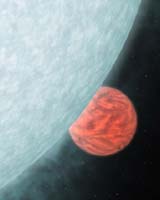
Astronomers using the Spitzer Space Telescope said Wednesday they have detected a strong heat-radiation signature directly from a planet closely orbiting a nearby star. “The effect we’ve seen is enormous,” lead researcher Drake Deming of NASA’s Goddard Space Flight Center told SpaceDaily.com.
“The heat energy of the planet is one-half of a percent of the star at this wavelength.”
The planet, called HD 189733b, orbits a star about 63 light-years from the Sun in the direction of the Dumbbell Nebula. It is orbiting very near to the star – only 2.8 million miles, or slightly more than 3 percent of the distance between Earth and the Sun.
HD 189733b actually was discovered last year by Francois Bouchy and colleagues at the Marseille Astrophysics Laboratory in France. Gauging Doppler shifts in the star’s motion, they were able to determine the planet is about 1.25 times Jupiter’s diameter and 1.15 times its mass. It also has a density of about 0.75 grams per cubic centimeter – low enough to classify it as a gas giant like Jupiter, and close enough to classify it as a Hot Jupiter, as astronomers call such planets. The planet circles HD 189733 every 2.219 days.
From its distance and the temperature of the parent star, Bouchy’s team estimated the temperature of HD 189733b’s cloud tops at several hundred degrees Celsius – at least – but they could not measure directly the heat or light emitted by the planet.
“Our direct measurement confirms this estimate,” Deming said. His team used Spitzer to measure the overall infrared radiation from both the star and the planet, and then compared the data with the radiation from the star when HD 189733b passed behind it.
The difference showed the planet’s surface is a scorching 844 degrees Celsius (about 1,550 degrees Fahrenheit) – far too high for liquid water to exist, and thereby rendering slim the chances that life emerged there. In fact, he said, “the planet may be losing its atmosphere because of the heat.”
Deming said HD 189733b’s heat signal is so strong that Spitzer actually could resolve its disk, “in the sense that our team could tell we were seeing a round object in the data, not a mere point of light. The current Spitzer observations cannot yet make a temperature map of this world, but more observations by Spitzer or future infrared telescopes in space may be able to do that.”
Last year, Deming’s team, along with a group at the Harvard- Smithsonian Center for Astrophysics, used Spitzer to make the first direct detection of light from two other previously detected Hot Jupiters: HD 209458b and TrES-1.
Deming’s team includes Joseph Harrington of Cornell University, in Ithaca, N.Y.; Sara Seager, of the Carnegie Institution in Washington, D.C., and Jeremy Richardson of Goddard’s Exoplanets and Stellar Astrophysics Laboratory.
