

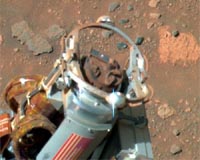
For the first time in its 29-month mission on Mars, NASA’s Spirit rover turned on its battery heaters. The rover took the action automatically at 8:15 a.m. local solar time on Mars on Sol 865 (June 9).
The heaters activate when local temperatures drop to about minus 19 degrees Celsius (minus 2 degrees Fahrenheit). The twin rovers Spirit and Opportunity can operate without internal heat as long as their operating temperature remains above minus 20 degrees C (minus 4 degrees F.).
This is the first time the heaters have been necessary on either rover, mission controllers at Jet Propulsion Laboratory reported Friday.
Meanwhile, since Spirit began its winter operations on McMurdo Hill, in the Gusev Crater region on Mars, the science and engineering teams at NASA’s Jet Propulsion Laboratory have held joint meetings every few weeks to track the rover’s progress and come up with a strategic plan that balances engineering resources with scientific productivity.
Last week, Spirit began acquiring the 22nd column of the 27-column McMurdo panorama image it has been compiling and completed the seventh of nine photon transfer calibrations – procedures designed to measure electronic noise (unwanted signals) picked up by imaging sensors that convert light into electrical current in the rover’s cameras.
Spirit also conducted studies of a soil target nicknamed Halley Brunt, an undisturbed exposure of bright sparkly bits of soil near the rover’s left front wheel.
The work included five hours of examination with the alpha particle X-ray spectrometer, 10 hours of examination with the Moessbauer spectrometer, and acquisition of microscopic images.
Sol-by-sol summaries
Sol 874 (June 18): Spirit acquired Part A of column 22 of the McMurdo panorama.
Sol 875: Spirit studied soil target Halley Brunt with the alpha particle X-ray spectrometer.
Sol 876: Spirit completed a photon transfer calibration of the microscopic imager. Spirit also acquired a panoramic view of a dune field called El Dorado and conducted remote studies using the miniature thermal emission spectrometer.
Sol 877: Spirit acquired navigation camera images of the rover’s tracks and continued to make remote observations using the miniature thermal emission spectrometer.
While communicating with the Odyssey spacecraft as it passed overhead, Spirit calibrated the miniature thermal emission spectrometer, took images of a sand ripple using the hazard avoidance cameras, and made observations of the sky and ground using the miniature thermal emission spectrometer.
Sol 878: Spirit completed a dust monitoring assessment of the panoramic camera’s mast assembly, acquired panoramic camera images to measure atmospheric dust opacity (known as a tau measurement), and conducted sky and ground observations using the miniature thermal emission spectrometer.
Sol 879: Plans called for Spirit to complete acquisition of Part B of column 22 of the McMurdo panorama and make more observations with the miniature thermal emission spectrometer.
Sol 880 (June 24): Plans called for Spirit to take microscopic images of Halley Brunt and then switch tools to the Moessbauer spectrometer for a 10-hour study of the same target.
As of sol 877 (June 21), Spirit’s total odometry remained at 6,876.18 meters (4.27 miles).
