

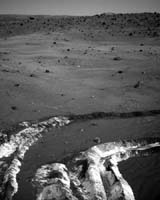
While driving eastward toward the northwestern flank of the peak called McCool Hill, in the Columbia Hills of Gusev Crater, the wheels of NASA’s Mars Exploration Rover Spirit churned up the largest amount of bright soil discovered so far in the mission.
This image from Spirit’s navigation camera, taken on March 21, the rover’s 787th Martian day, or sol, of exploration, shows the strikingly light tone and large extent of the deposit.
A few days earlier, Spirit’s wheels unearthed a small patch of light-toned material informally named Tyrone. In images from Spirit’s panoramic camera, Tyrone strongly resembled both Arad and Paso Robles – two patches of light-toned soils discovered earlier in the mission.
Spirit found Paso Robles in 2005 while climbing Cumberland Ridge on the western slope of Husband Hill another of the seven peaks in the Columbia Hills, named for the fallen crew of shuttle Discovery.
In early January of this year, the rover discovered Arad on the basin floor just south of Husband Hill. Spirit’s instruments confirmed the soils contained a salty chemistry dominated by iron-bearing sulfates. Spirit’s miniature thermal emission spectrometer is analyzing this most recent discovery, and researchers will compare it with those other deposits.
The discoveries indicate that light-toned soil deposits might be widely distributed on the flanks and valley floors of the Columbia Hills region. The salts may record the past presence of water, because they are easily mobilized and concentrated in liquid solution.
