
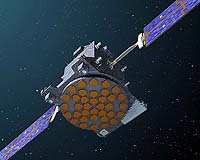
Spirent Communications will provide Radio Frequency Constellation Simulators to support the development and in-orbit validation phases of the Eu- and ESA-sponsored Galileo navigation satellite project, the company said Thursday.
Spirent has been selected by Alcatel Alenia Space and Thales, the organizations overseeing, respectively, the Ground Mission Segment and Test User Segment elements of the project. Spirent’s RF Constellation Simulators will generate radio frequency signals representative of the real transmissions from Galileo spacecraft when the array is fully deployed in 2010.
Spirent will test the performance of the GMS and user receivers, components that form critical elements of Galileo’s development. The GMS stations control the satellite constellation and the TUS forms the basis for future Galileo receivers that will be used in applications on the sea, in the air and on land.
The RFC simulators also will test performance of the GMS and TUS receivers, including in “adversarial and error conditions,” Spirent said in a statement, to improve the resilience of the system.
“Spirent’s simulation systems will enable the Galileo project to fully test critical receiver technology in advance of full system availability,” said Martin Foulger, managing director of Spirent Communications Wireless and Positioning.
