
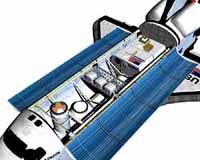
Spacehab announced Wednesday that it has signed a contract modification with NASA worth $42.4 million to provide its pressurized Logistics Single Module (LSM) and unpressurized Integrated Cargo Carrier (ICC) for two new International Space Station (ISS) assembly and cargo resupply missions.
These two new missions, STS-116 (12A.1) and STS-118 (13A.1), were added to Spacehab’s Research and Logistics Mission Support contract with NASA and are currently on NASA’s Space Shuttle manifest to launch in calendar year 2003. Spacehab will commence work on the missions immediately. These LSM/ICC flights will be Spacehab’s sixth and seventh resupply missions to the ISS.
The dual assembly and resupply objectives of each of these two missions are ideally suited for Spacehab’s versatile inventory of modules (single and double) and pallet carriers (horizontal and vertical).
NASA’s selection of the LSM and horizontal ICC configuration for each of these new missions allows for co-manifesting of critical ISS structural elements and Orbital Replacement Unit (ORU) subsystem components.
Along with modifications made to the Space Shuttle Columbia, Spacehab’s flexibility in locating its carriers within the shuttle cargo bay is enabling NASA to use this orbiter for missions to the ISS, marking STS-118 as Columbia’s first visit to the orbiting space station.
Spacehab President and Chief Operating Officer Michael E. Kearney stated, “The addition of these two missions reflects how Spacehab can help NASA with the challenges faced when managing the resources of the nation’s space program.
“Our ability to offer a combination of valuable services in a single mission, such as crew exchange, external hardware, and logistics support, is an important contribution to ISS assembly and operations.”
Spacehab’s next shuttle flight, STS-107, is a dedicated research mission currently scheduled to launch in July 2002. This mission will debut the flight of Spacehab’s Research Double Module, a $100 million asset. This flight also marks the 18th mission for Spacehab, which has achieved nearly $500 million in revenue for supporting NASA research and logistics missions.
