

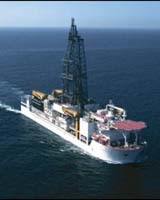
The Integrated Ocean Drilling Program, the world’s largest and most ambitious scientific ocean research program operating today, has expanded its base of international support by welcoming the Republic of Korea as its newest member. South Korea’s membership was signed into a memorandum of understanding (MOU) by officials from Japan, the United States, and the Republic of Korea.
The MOU creates an Interim Asian Consortium, with the Korean Institute of Geoscience and Mineral Resources (KIGAM) as its first affiliated institution. Japan’s Ministry of Education, Culture, Sports, Science and Technology (MEXT), and the U.S. National Science Foundation (NSF) jointly fund IODP, providing maximum support of most IODP science and drilling operations.
“South Korea brings welcome intellectual and scientific resources to the Integrated Ocean Drilling Program,” says Manik Talwani, president & CEO of the IODP International Management (IODP-MI)corporation. “The first to initiate a new Asian scientific ocean-drilling consortium, South Korea also brings new energy and future promise.”
As an IODP member nation, South Korea will contribute scientists to upcoming IODP research expeditions. The next expedition, tentatively scheduled for early summer 2007, will conduct shallow-water, subseafloor investigations along the intercontinental shelf off New Jersey’s coast.
“South Korea’s investment in IODP,” says James Allan, IODP program director at NSF, “supports critical research that generates new scientific data about how the Earth works.” By monitoring and sampling subseafloor environments, IODP scientists probe questions about climate and environmental change, solid Earth cycles and processes, and the largely unknown deep biosphere.
“The more resources we bring to bear on scientific ocean-drilling investigations,” adds Allan, “the more robust IODP can become, and the more we can learn about the planet we live on.”
