
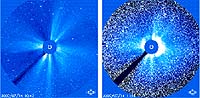
Solar storms that bombard earth’s atmosphere with electrically charged particles contribute to the destruction of the upper-level ozone, scientists confirmed in Wednesday’s issue of Geophysical Research Letters.
NASA researchers used satellites to examine the impact on the northern hemisphere of solar explosions that sent positively-charged protons streaming to earth between July 14 to 16 2000, in what scientists called the third largest “solar proton event” in 30 years.
Once they reached the upper atmosphere, the protons broke up nitrogen gas molecules, creating nitrogen oxides which can last for weeks to months and destroy up to nine percent of the ozone in the upper stratosphere, at 15 to 50 kilometers (10 to 30 miles) of altitude, the study said.
“A lot of impacts on ozone are very subtle and can happen over long periods of time. But when these solar proton events occur you can see immediately a change in the atmosphere, so you have a clear cause and effect,” said Charles Jackman of NASA’s Goddard Space Flight Center Laboratory for Atmospheres, the lead author of the study.
The solar protons also break the atmosphere’s water vapor molecules into hydrogen oxides which can destroy up to 70 percent of the ozone in the middle mesosphere, located from 50 to 90 kilometers (30 to 55 miles) of altitude. The hydrogen oxides last only for the duration of the solar proton event, however.
Only a small percent of the ozone is located in the mesosphere and upper stratosphere, while over 80 percent of the protective gas which maintains earth’s temperature and shields its life from the sun’s ultraviolet radiation is located in the middle and lower stratosphere, at 15 to 35 kilometers (10 to 20 kilometers).
“If you look at the total atmospheric column, from your head on up to the top of the atmosphere, this solar proton event depleted less than one percent of the total ozone in the Northern Hemisphere,” Jackman said.
The ozone layer is also depleted by human industrial activity, especially emissions of human-produced compounds such as chlorofluorocarbons (CFCs) and halon gas.
