

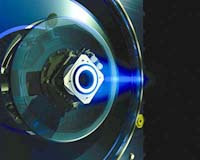
The spacecraft is now in its 139th orbit, in good operational status and with all functions performing nominally. As previously, the spacecraft was operated in electric propulsion mode almost continuously.
This week we had no flame-outs, probably due to the adopted strategy not to thrust when the orbital altitude is less than 10 000 km. The procedure to automatically re-start the engine after a flame-out will be uploaded to the on-board software this week. Once this is in place, the thrust phase will no longer be interrupted.
The total cumulated thrust time is now more than 946 hours and SMART-1 has consumed almost 15 kg of Xenon. Even with such a low fuel consumption the electric propulsion engine has so far provided a velocity increment of about 665 ms-1 (equivalent to about 2400 km per hour). The electric propulsion engine’s performance, periodically monitored from telemetry data and by ground stations tracking, continues to show a small over performance in thrust, varying from 1.1% to 1.5% over the last week.
The newly adopted strategy to thrust in a direction perpendicular to the position vector in the orbital plane has produced a large perigee increase in the last week of more than 1200 kilometres (see orbital elements and orbit picture).
The degradation of the electrical power produced by the solar arrays is now slowing down considerably. As a matter of fact the available power has remained more or less constant in the last 15 days. This means that the degradation by radiation has matched the increase of solar irradiance due to the nearing of the Earth’s perihelion, so that the net effect is zero.
This is explained by the fact that no direct proton radiation from solar activity was experienced and the fact that the spacecraft now stays outside of the radiation belts for a considerable part of its orbit.
The communication, data handling and on-board software subsystems have been performing very well in the last week.
The thermal subsystem continues to perform well and all the temperatures are as expected. The temperature of the optical head on star tracker #1 is now lower than before.
This is due to the changed thrust attitude which reduces the exposure to the Sun of the -Z side of the spacecraft. Other attitudes are being considered in order to test the dependence of the star tracker’s temperature upon the spacecraft’s attitude.
