
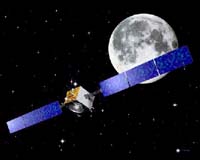
The spacecraft has passed now completed over 250 orbits, is in good status and with all functions performing nominally. The eclipse season is now over, with the last eclipse occurring on 21 March. The longest eclipse occurred on 13 March (lasted for 2 hours and 15 minutes) and stressed the power systems to their maximum limit.
The spacecraft performed extremely well throughout this period and the power and the thermal control systems have been able to overcome this ?long night? Without a glitch.
All the autonomous functions on board designed to monitor the eclipse phase and predict the power conditions have also been working very accurately. Now SMART-1 can re-start its journey to the Moon.
The thrusting phase has restarted to increase further the orbit apogee. The new strategy involves thrusting around perigee at every revolution for about 8 to 10 hours for the next month. More details on this new strategy will be included in the next report.
