

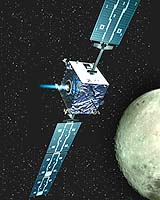
The spacecraft is now in its 169th orbit, in good status and with all functions performing nominally. The spacecraft has been functioning in electric propulsion mode for the whole week, continuously thrusting since the flame-out and subsequent entry into safe mode last week.
This has allowed SMART-1 to perform its largest orbit increase since the start of the mission: 2000 km added to the semi-major axis in one week!
The total cumulated thrust so far is more than 1313 hours (consuming 20.8 kg of Xenon) and has provided a velocity increment of about 930 ms-1 (equivalent to 3350 km per hour).
The electric propulsion engine’s performance, periodically monitored by means of the telemetry data transmitted by the spacecraft and by radio-tracking by the ground stations, continues to show a small over performance in thrust, varying from 0.9% to 1.2% over the last week.
The degradation of the electrical power produced by the solar arrays has now ceased. The power available has remained virtually constant for almost 1000 hours. The graph below displays the measured power produced by the solar arrays when the EP is operating at full power starting from the beginning of mission.
The communication, data handling and onboard software subsystems have been performing well in this period.
The thermal subsystem continues also to perform well and all the temperatures are as expected. The temperature of the star tracker optical heads has remained high, though.
