
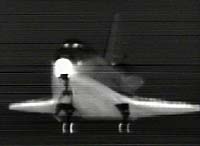
The US space shuttle Atlantis touched down early Monday at the Kennedy space center in Cape Canaveral, Florida, after a successful 10-day mission to fix-up parts of the International Space Station.
The seven crew members, including Russian cosmonaut Yuri Usachev, completed all scheduled tasks with no significant problems. The main purpose of the mission was maintenance on two modules of the future International Space Station (ISS).
The 30-tonne complex, assembled in December 1998 and currently composed of two modules: the US-built Unity and the Russian module Zarya, was in need of repairs in preparation for the arrival of its first crew in later this year.
Atlantis arrived at the Kennedy center at 12.20am EDT.
During a space-walk lasting close to seven hours, astronauts Jeff Williams and Jim Voss installed a camera cable and security handrails to the exterior of the ISS, and replaced a faulty communications antenna.
The astronauts had a lengthy to-do list in this latest mission — Atlantis’ 21st — including completing the assembly of a Russian-made mechanical arm and testing the integrity of a US-made one.
Their most important task was to replace a charger and four of the six batteries needed to generate electricity for the ISS that no longer work.
Ten smoke detectors were changed aboard Zarya, fire extinguishers were replaced, and fans installed to improve air flow aboard the module to remove the risk of exposure to toxic fumes experienced by previous crews. New cables meant to increase the capacity of computer systems were also installed.
The astronauts transferred more than a tonne of material from the space shuttle to the ISS, including computers, printers, carpets, an exercise bicycle, a sewing kit, clothes and 180 liters of water.
The astronauts completed all tasks ahead of schedule, enabling them to perform additional tests.
Commander Jim Halsell and pilot Scott Horowitz fired the shuttle’s thrusters 27 times late Tuesday and early Wednesday, moving the ISS up 16 kilometers (10 miles) to a total altitude of 344 kilometers (215 miles).
The complex is now at the correct altitude for the expected arrival of the Russian service module Zvezda in July.
Copyright 2000 AFP. All rights reserved. The material on this page is provided by AFP and may not be published, broadcast, rewritten or redistributed.
