
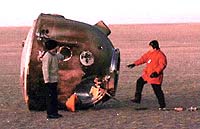
The maiden flight of Shenzhou was originally planned to be a manned mission, according to a report that was distributed here yesterday (Mar.11). Wisers Information reported that the mission was changed to unmanned because a near flawless performance of the capsule could not be guaranteed.
An aerospace expert in China, who was knowledgeable to the detailed planning of the Shenzhou maiden mission last November, disclosed that the Party Leadership had ordered the change, due to the historic significance of the flight and national pride. Beijing wanted an “error-free” mission, compounded by worldwide scrutiny.
Another factor was the lack of a centralized mission preparation which impacted safety verification. Components of the Changzheng (“Long March”) 2F launch vehicle were manufactured mainly in Beijing and Shanghai in eastern China. In addition poor launch and on-orbit control infrastructure made for further concerns.
The rocket lifted off from the Jiuquan Satellite Launch Center in Gansu Province in china’s northwest. Once launched, the mission was controlled from the Beijing Aerospace Directing and Controlling Center.
Other relevant departments of the Chinese Academy of Sciences and the Ministry of Information Industry participated in the designing, manufacturing and testing in the project.
Mirroring the course of early American and Russian space programs in preparing the first manned mission, China had systematically built up its capabilities to launch and retrieve living payloads in recent years.
The aerospace expert quoted by Wisers Information and who was a delegate to the National People’s Congress (NPC) in Beijing this past week, said China had successfully orbited and recovered a rat, a rabbit and a dog since 1997.
The dog spent several days in space and was housed in a cage. Air supply came from mixing two bottles of oxygen and nitrogen.
The world space community anticipates that China will orbit its own yuhangyuan (astronaut in Chinese) by next year.
China News Today
