
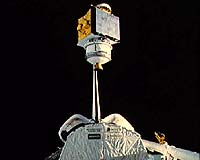
SES Americom announced today that its Satcom K-2 satellite was successfully and safely removed its GEO orbital position after 16.3 years of excellent service to the broadcast industry.
Launched on the Space Shuttle “Atlantis” on November 26, 1985, the satellite operated at 81 Degrees West and provided service seven years beyond its design-life.
The spacecraft’s first and last customer was NBC; it served as the home of the first Ku-band television network distribution service for the then RCA-owned broadcaster.
NBC has been using K-2 steadily throughout its life; as late as December 2001, the broadcaster depended on the satellite for contribution feeds and news backhauls while it operated in inclined orbit.
Other applications on the satellite included some of the earliest private corporate data networks and one of the first channels of ethnic programming distributed by TV Japan to the backyard dish market, a forerunner of today’s widely recognized direct-to-home services.
The then-RCA-built satellite was based on the Series 4000 bus and was the first all-Ku-band spacecraft in the Americom in-orbit fleet, being launched two months before its sibling satellite K-1.
Considered “high-powered” for its time, the K-2 satellite featured 16 wideband (54 MHz) transponders with 45 Watts of power each with full CONUS coverage.
In an interesting historical twist, K-2’s ground spare, built as K-3, became the first ASTRA satellite 1A.
Walter Braun, SES Americom’s Senior Vice President of Engineering, Operations and Vendor Management said, “Originally designed to provide nine years of service, K-2 exceeded the expectations of both AMERICOM and our customers’ – it’s a great reflection on the quality of the spacecraft as well as the quality of the team that operated it. In short, K-2 was a great bird and a superb mission.”
