

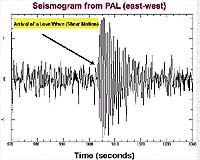
The growing world network of seismic stations is increasingly useful for monitoring more than earthquakes, say university geoscientists who are developing a new specialty called “forensic seismology.”
They study seismograms as records of industrial explosions, clandestine nuclear weapons testing and terrorist bombings.
“Forensic seismology has its roots in the verification of small nuclear explosions,” says University of Arizona seismologist Terry C. Wallace. “But it clearly is also useful in putting constraints on terrorist bombs.”
Wallace discussed the topic May 28 at the American Geophysical Union meeting in Washington, D.C. AGU meeting organizers describe the scientific community as “a largely untapped resource for detecting the signatures of terrorist activity. Researchers operate networks of sensors, and if terrorist activity is detectable, it is quite likely that the evidence will first appear on a data collection system operated for other purposes. Scientists are therefore strongly positioned to serve as the technological equivalent of a neighborhood watch.”
Wallace, his former post-doctoral associate Keith D. Koper, who is now on the faculty at St. Louis University, and van der Vink a few years ago collaborated in research on how seismic records might be used to monitor small or moderate-sized secret nuclear weapons tests.
They conclude that the worldwide seismic network has been proved both extensive and sensitive enough to monitor violations of the Comprehensive Nuclear Test Ban Treaty (CTBT).
