
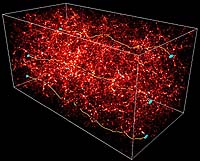
Using state-of-the-art image analysis software, largely developed at the TERAPIX data analysis and processing center in Paris, the team was able to analyze the light from 200,000 very distant and faint galaxies, looking for the minute distortions that, in theory, should occur as the light passes through the gravitational fields of intervening dark matter.
Using this information the team has developed the first “map” of dark matter in that area of sky, allowing researchers to visualize how it condensed out of the early universe and distributed itself over the course of time.
The analysis has revealed the presence of a vast matrix of interconnected dark matter. The result is not only a significant technological feat, but also a major advance in astronomy and cosmology.
According to Dr. Greg Fahlman, Director of the Canada-France-Hawaii Telescope, the results are but a preliminary view of what the future is promising.
“By 2002 we will have a new wide-field imaging camera on the telescope that will cover, with improved sensitivity, an area of sky 3 times greater than the current camera. This new instrument will greatly enhance our ability to map the cosmic distribution of dark matter,” said Fahlman.
MegaCam, as this new camera is called, will provide astronomers with the data they need to develop significantly more accurate models of the universe.
“Our goal,” Fahlman adds, “is to help create the first distribution maps of dark matter across the sky, similar to the distribution maps you currently see for galaxies.”
The Canada-France-Hawaii Telescope is funded through the National Research Council of Canada (NRC), the Centre National de la Reserche Scientifique (CNRS) in France, and the University of Hawaii.
