
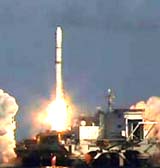
PAS-9, a high-power Hughes 601HP satellite built for PanAmSat by Hughes was successfully launched Friday on a Sea Launch rocket from the middle of the Pacific Ocean. Liftoff occurred at 3:42 p.m. PDT, and PAS-9’s first signals, confirming normal operations, were received about 5:19 p.m. PDT at the Sydney, Australia, satellite tracking station.
The PAS-9 Atlantic Ocean Region satellite is the fourth Hughes spacecraft PanAmSat has launched in seven months. It is also the first among these recent launches that will provide international services.
PAS-9, once on-station at 58 degrees West longitude, will provide at least 15 years of video, data and Internet services in C-band and in Ku-band for the Americas, the Caribbean, and western Europe, plus direct-to-home services for Mexico in Ku-band. The satellite features 48 transponders, 24 in C-band and 24 in Ku-band.
The high-power 9,900-watt satellite features Hughes’ leading technologies, including advanced dual-junction solar cells with 21 percent conversion efficiencies and XIPS, a xenon ion propulsion system that allows for a reduction in propellant mass of about 90 percent compared to chemical bipropellant systems.
At time of launch, PAS-9 weighed 3,659 kilograms (8,067 pounds). Once in position 36,000 kilometers (22,300 miles) above the equator at 58 degrees West longitude, the satellite will weigh 2,389 kilograms (5,268 pounds).
PAS-9 is PanAmSat’s 21st satellite. PAS-1R, a Hughes 702, is scheduled for launch in the fourth quarter of 2000. PAS-10, a Hughes 601HP, and Galaxy IIIC, another Hughes 702, are scheduled for launch in 2001.
